Run Brett, Run
This is awesome on so many levels that I just had to share:
I found out about this video from Sophie Brookover via Facebook. Sophie reports that she is planning to run the race — and perhaps even throw the race all for the cause.
I love it when a clever fundraising idea is promoted so brilliantly and I hope that this will be a huge success for Brett Bonfield and the teens who need a space to hang out at the Collingswood Library.
Click here for more info on the 5K Race and Collingswood Book Festival.
Make ALA Connect Work For You: An appeal for Notifications ON!
 UPDATE 7/28/09, 3:00 PM: Check out Jenny Levine’s post on changes coming to ALA Connect–esp. regarding improvements in notifications!
——————————————
I’m excited, hopeful, and joyously optimistic about ALA Connect, ALA’s hybrid social network, bulletin board, listserv, calendar, project management tool.
Like all networks ALA Connect is only as useful and powerful as the number people that use it; and in fact it is getting exponentially more useful and powerful with each new user.
The more I use the ALA Connect, the more I realize that selectively turning on Email Notifications is key (for me) to integrating Connect into my professional life. This ensures that updates (the ones I want anyway) are pushed out to me, which is important as I only tend to pay attention to whatever wanders into my field of vision…
 I’m appealing to you, dear reader; help ALA Connect thrive and grow by logging in and turning on your notifications too–and help spread the word by posting this attractively designed and competitively-priced banner ad (in both border and non-border stylings you’ll notice) on your blog, homepage, or social network of choice. Extra points for tattooing directly upon your body. No pictures please, I’ll take your word for it.
Another feature I’ve found useful for keeping up in Connect is the ability to view my unread messages through the “My Unread” page and feed. Links to your “My Unread” content can be found on the lower right of the ALA Connect page under “Community Notifications”. (These links will work for you if you’re logged in to ALA Connect–otherwise you’re seeing “access denied” messages.)
To learn more about ALA Connect, check out the these great video tutorials created by Emerging Leaders Group I (aka Melissa Dessent, Ahniwa Ferrari, Jaime Hammond, Jennifer Jarson, Jason Kucsma). The videos are in the process of being uploaded to ALA Connect proper.
Thanks everyone, see you on ALA Connect!
A New Role at ALA Annual
I’m in Chicago in order to attend what must be my 20th American Library Association annual conference. I have lost count of how many annuals I have attended. My first was Los Angeles in 1983 when my family began accompanying my mother, who is also a librarian, to the conference for our summer vacation. LA was just the first of many other conferences. I also went to Dallas, New Orleans, New York, Atlanta, San Francisco (a couple of times), Chicago (also a couple of times) and several others that I have since forgotten.
ALA meant only one thing to me when I was growing up: free stuff. I looked forward to the seemingly endless rows of exhibits that promised loads of goodies to bring home. At first one of my parents would accompany me up and down the aisles but I was eventually allowed to walk through the exhibits by myself. As long as I met my parents at the previously established meeting time, I could spend as much time as I wanted looking at all of the books. At the time, it never occurred to me that I might one day attend the conference as a librarian.
Not long after I started library school in 2002, I asked my mother (as I did every year) if she was going to attend the annual meeting in Toronto. After she replied that yes, she was planning to attend, I remember imagining yet another experience of walking up and down the exhibit aisles filling my bags with swag. Then it slowly dawned on me that the upcoming conference would be an entirely different experience–I would be attending ALA as a soon-to-be-librarian. I would actually have to go to meetings and presentations!
My experience in Toronto was completely different from any of my previous conferences. I spent a lot of time walking or riding the bus from one meeting to another and I barely had time to go to the exhibits. People sometimes say that they find ALA overwhelming and before attending my first conference as a librarian, I didn’t really understand what they meant. How could a place full of free books be overwhelming? Toronto thoroughly disabused of this idea. Just figuring out which meetings and presentations to attend can take quite a bit of time and energy.
Now I am once again attending ALA in a new role. As a doctoral student, only a few of the meetings mesh with my particular research interests. This means that I feel quite a bit of pressure to attend all relevant meetings even when they are scheduled at the same time. I am constantly looking at my printed schedule to make sure that I don’t miss anything. The exhibits are, of course, secondary.
Before becoming a librarian myself, I had no idea that there were many librarians out there who were quite disappointed with ALA and its work. My mother always seemed recharged and energized for her work after attending a conference. Of course, this is the essence of some librarians’ problems with ALA. What does one get out of being a member other than the conference?
For me, being a member of ALA reminds me that I am part of a larger community. Before returning to school, I worked in a small theological library — a setting that is very different from a public library. By reading through my American Libraries every month, I was reminded that even though my library had a specialized mission, we were still part of the wider library world. Now that I am a student again, I feel even further removed from librarianship. Attending this conference has helped me remember why I am in a library and information science doctoral program. When I am in the McCormick Center, surrounded by 27,353 other librarians, I recall that my research is not just for my own edification but that it will also aide the profession as a whole.
By attending the conference, I am reminded that even though I no longer work in a library I am still a librarian. I still have one more day of running around the conference center to attend meetings and racing through the exhibits. And, like my mother, I hope to return to New Jersey from this conference recharged and energized for my classes in the fall.
Summer Reading for Grown-Ups

Are you like me and have a pile of books you’ve gathered this year and haven’t had time to read? Will you get to them all this summer? Maybe you participated in the summer reading program at your Public Library as a child and loved all the incentives, prizes and competition. I was a fixture in Mary Jacobs Library in Rocky Hill each summer. That’s where the pattern of a summer reading plan started. I’m hoping that even just writing  about this is the incentive I need to start finishing more books each summer. I’m excited to see that Adult summer reading programs are popping up all over. Library websites and Facebook pages allow the programs a great online presence and wider audience. I may have found the answer to my summer reading dilemma.
For me, summer seems to be the perfect time to catch up on reading- At least in theory. As a school librarian, I have my summers free (well, I’m using that word loosely- Those that don’t have summer jobs like most of us are free, that is) from my full-time work. So, every year, when school gets out in June, I set out with a noble plan to read hundreds of books before Labor Day.
My initial strategy for summer reading-
• Gather reading lists, YA, Adult, and non-fiction.
• Read recommendations on Shelfari, and pages for “grown-up” suggestions, like Katherine Day’s suggestions, found at http://tinyurl.com/nehv2a
• Gather the piles of books I’ve gathered at ALA and BookExpo that I plan to read and then give away as prizes or promotion at school.
Then what happens?
I start my first summer book with high hopes and optimism and often finish it right away, then I get 2 or 3 going, eventually getting distracted by a fourth and next thing I know, I’m sitting on the beach in mid-July with unfinished books in my beach bag, and enough frustration to last until Thanksgiving. Would a summer reading program designed for busy adults help? I think so. Don’t you get more done on a day when you have several things scheduled? Time and project management are essential to my productivity. It sounds rigid, but I end the day much more satisfied when I accomplish more. That’s why I think summer reading program for adults are worth promoting.
When I make my reading plan in June, I never factor in that I’ll be doing outdoor activities every sunny day, traveling as much as my job allows, repairing my house, cleaning my garage, taking care of family, and generally just trying to get enough energy back to start another school year in September. Sometimes I need the freedom from so much “input/output” that goes on during the year that reading another “heavy” book in the summer might not be what the doctor ordered. When did my reading excuses become so “adult”? Gerie Madak posted this quote in reference to Bridgewater’s Adult Summer Reading Program, “Too often adults deny themselves the pleasures of reading for fun. They’re so busy taking care of everyone else that they begin to regard reading as a self-indulgent pastime they don’t have time for because of chores, appointments, and deadlines.” I’d like to find the happy medium between the guilt of not reading and the gluttonous satisfaction of reading more books than someone else. These programs aren’t designed to be competitive, they’re more like open book clubs for the summer months.
So, in creating this post for LG in early July, I’ve decided to stop being so hard on myself and celebrate each book I do finish OR start! I’ll do more walking, yoga, and reading for pleasure. Unlike my students, I don’t HAVE to read a certain number of books to complete a summer reading project. Unlike the summer reading program I promote in school, I won’t win a prize for reading 100 hours at my public library (that’s changed in many places and I honestly did not know that until I started researching for this post). Since I began writing this, I’ve learned about some great adult summer reading programs. Like a book club, I think it’s great to have deadlines and discussion when you’re reading. The prizes are cool, too, don’t get me wrong- like restaurant and movie gift certificates, and of course, books!
My Summer Reading Tips
- Make a “wish list” of books you’d really like to read, or mark up Nancy Pearl’s Book Lust with all your must-reads, like a book bucket list
- Read a book about a hobby, new or otherwise
- Hang out at the library with your kids or friends — you’ll be inspired
- Join a successful Summer Reading program for adults, like the one in Seattle (Their summer reading Facebook page: http://tinyurl.com/nrga4h) or Burlington County (http://tinyurl.com/mjzge8)
Happy summer- Happy Reading!
I’d love to know more about dynamic summer reading programs for adults, and if you have your own plan that you’d like to share.
Teaching Generation M handbook–"hot off the presses!"
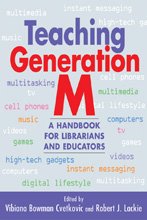
-Robert Lackie
Blogger’s Block
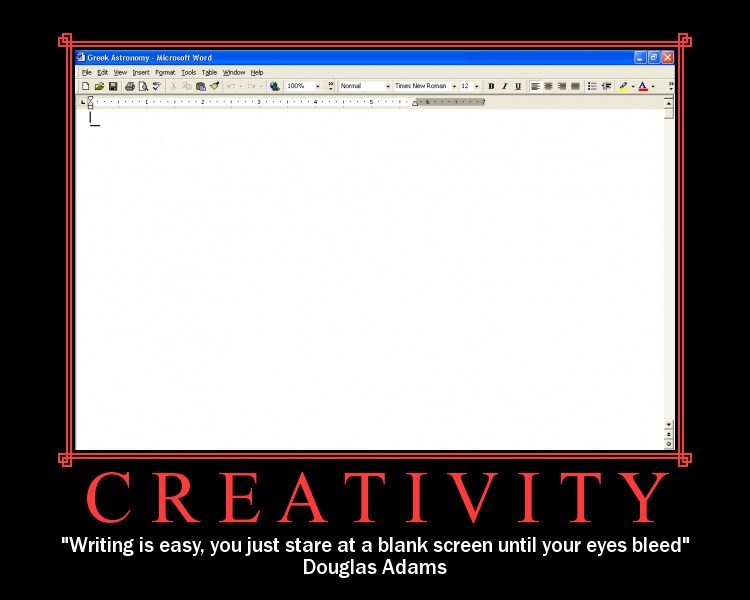 For the last few months I have been suffering from a writer’s block of sorts that has made it impossible for me to write a blog post of any length or substance. I have done other writing, just no blogging so it is a true blogger’s block. This has never happened to me before and I have spent the last few weeks honestly trying to figure out the cause is behind this blockage.
It is not a lack of ideas. I have lots of ideas for posts, they come to me at odd moments and usually when I am nowhere near a computer (or even a piece of paper and pen to jot down a quick outline). Lately, however, when I finally sit down to write a post one of three things seems to happen:
1. I start writing and suddenly I feel as if it has already been said before. What seemed like a brilliant blog post when I thought of it, now feels like it is just rehashing the same conversations that we have been having on libraryland blogs for the last few years. Is it possible that we have blogged to death the whole Library 2.0 movement? I am pretty sure we have. If we have, what is the next big discussion topic on the horizon?
2. I start writing on a timely topic but I don’t have time to finish and by the time I go back to polish it off it is no longer relevant or timely. My responsibilities at MPOW have increased greatly since I was promoted to Programming Coordinator, my son is older and involved in activities that require me to be the chauffeur, our older home is undergoing some renovations, and I have begun doing a lot more speaking engagements once more . All of these factors leave me with no time for sustained thinking or writing. I used to blog late at night, but lately my brain is exhausted by that point and when I do write it is mostly gibberish (trust me on this).
3. I start writing and feel like I am writing too much about MPOW and all the awesome things we do here. This is not the intended focus of Library Garden — all the bloggers on our team agree that we want it to be a broader conversation about libraries rather than a simple “how I did it good” type of reporting. Not that we haven’t posted occasionally about cool things we are doing at our libraries or places of work, but we want LG to be more than that and I am aware of this. However, I am so focused these days on planning and running programs that I have little left in me at the end of the day to discuss.
So, this brings us to this particular post. This is my “break the blogger’s block” post. It is the post to get me posting again. I can’t stay in this rut of not posting and so I sought advice online on how to break writer’s block. Here are the 3 of the most common pieces of advice I found:
1. Write on a Schedule: This is not likely to happen unless I start getting up at 5:30 am as is my only free unscheduled time at this moment that I could regularly guarantee nothing else happening in my day. I am a morning person, but even that is too early for me.
2. Set Deadlines and Keep Them: I have a lot of deadlines in my life to keep and I am pretty good at meeting deadlines. Blogging is a hobby and a creative outlet and somehow a deadline makes it feel like more pressure on me and I don’t write well under pressure (actually, I evidently don’t write at all as can be seen by my lack of posts lately).
3. Work on more than one project at a time: I am always working on about 10 projects at a time at a minimum. Maybe not writing projects, but I always have too many things to juggle. I actually think working on too many things is my problem. I can not sustain a single train of thought long enough to write a cohesive and coherent post. I get distracted by too many other pressing tasks.
Hmmm… okay, so three common tips down and none are working for me. I worked my way through many more tips such as those above, and none seemed to be the solution. Until I found a good article called How-To Break Writer’s Block on Buzzle that seemed to actually have a few ideas that would work for me! So, this post is courtesy of tips # 7 and #10 from this article:
7. Write when you are tired. Write at the end of the day, when you are so exhausted that your mind isn’t interfering with the flow…
and
10. Lastly, write about having writer’s block. Seriously! Write about why you feel stuck. What is it that seems to be keeping you from writing? Free associate and write about it. When you get down to the reasons why you have writer’s block, you can address them and correct them.
I wrote this post when I was exhausted. I know it is not perfect or the best writing I have ever done, but at least it is a post to get me out of my rut. I have also analyzed the reasons for my blogger’s block and now that I have one post out again I am already excited about another post that I started working on recently. So, with any luck, I will have another post out within 48 hours.
If anyone else has experienced blogger’s block, I would love to hear stories, tips and advice on what you have done to overcome it. If anyone is currently suffering from blogger’s block, try reading the above article to see if it helps you like it did me or else read through this helpful list of resources I consulted to get me back in the blog saddle again:
20 Types of Blog Posts – Battling Bloggers Block
LEO: Overcoming Writer’s Block
Top 10 Tips for Overcoming Writer’s Block
How to Overcome Writer’s Block – 15 Tips
I am looking forward to attending the OCLC Blog Salon at ALA Annual in Chicago this year — and now that I have actually written a post I won’t feel like a fraud for attending. Oh, and if you plant to attend the blog salon, there is a Facebook page so RSVP today!
Creativity Image from: http://www.flickr.com/photos/alun/253596595/
4 out of 5 Library Gardeners Recommend Twitter to their Readers who Chew Social Media

As you are very aware, Twitter is everywhere! There’s no escaping it, whether you have a Twitter account or not. However, recently a lot of the attention was focused on the large number of “Twitter Quitters”-those who join Twitter and never go back. This article http://www.computerworld.com/action/article.do?command=viewArticleBasic&articleId=9132305 cites a Nielsen Co. report that “. . . 60% of Twitter users do not return to the microblogging site the next month.”
Maybe others have more information on that research, or a better understanding of that 60% figure, but to me not returning to the site doesn’t necessarily mean that people who sign-up for Twitter aren’t using it. I myself hardly ever “return to the site” (http://www.twitter.com) because I use other programs to tweet, as well as my iPhone. So while I am a very active twitterer (my current updates – or tweets – are over 5,000) my actual use of the site isn’t very high. I use a program called Tweetie on my iPhone and MacBook, and there are many other programs you can use to tweet, including TweetDeck, Seesmic and Twhirl.
I do believe that many people sign up for Twitter and never use it. If the report said that more than half of those who join Twitter never send any tweets or updates, this 60% figure would be clearer to me. However, since you really don’t need to return to the site to tweet, saying that 60% never do return might not mean anything.
How did the researchers determine this figure anyway? If they mean 60% of new users “do not use their account to tweet” after the first month it might make sense. You could easily tell how many times someone has tweeted (as long as they are public) no matter how they sent the tweet. You could see that a new user never tweeted again, whether it was from the site or another client. But the report didn’t say that new users don’t tweet, it said they never return to the site. This doesn’t mean that those who join Twitter haven’t continued to use the service in another way.
Twitter is an interesting tool and one that is increasingly useful, even to those who don’t have a Twitter account. For example, the Twitter search function is extremely useful, and does not require an account. You can search Twitter for all the (public) tweets on any particular topic by going to http://www.search.twitter.com. The advanced search features are especially neat, and include the ability to search by emotional content by using standard emoticons such as 🙂 or :-(.
The hashtagging of topics is another way to use Twitter without going to the site or ever sending out your own tweets. You can follow current events or topics or conferences (okay some people have had it with that) by following only the tweets that have the hashtag in them. (You can read some more on Twitter and hashtags here.)
Okay, I do admit, 60% is a big number, and other sites like Facebook and MySpace had higher retention rates right from the start, but Twitter has been experiencing crazy growth (http://blog.nielsen.com/nielsenwire/online_mobile/twitter-quitters-post-roadblock-to-long-term-growth/). Undoubtedly, people will join a new thing and try it when it is getting as much attention as Twitter has and, of course, not everyone is going to stay with it no matter what. When you have a lot of growth, you just are not going to keep everyone – especially if those who join are just compelled to try it because celebrities like Oprah are there. I would imagine that people who do not regularly social network might try Twitter and then abandon it because social networking isn’t a part of their lifestyle in general … they don’t Facebook or MySpace, or text or instant message, or surf the Internet for hours.
Just like all social sites or 2.0 tools, Twitter isn’t for everyone. I mean, I “get” the common complaint voiced by those who “don’t get” Twitter – even I don’t always care what people are having for lunch! I just skim over those tweets though because I do always care when they share an awesome link to an article or resource. I appreciate when they crack a joke that makes me smile in the middle of a stressful workday, or ask or answer an interesting question. Twitter all depends on whom you follow and who is following you – it is what you make of it. The particular network you have (or don’t have) on Twitter really makes or breaks it.  Signing up for Twitter and then not adding any followers, or following anyone else, and then quitting, is like having a phone number and then never making or receiving any calls and saying the phone is worthless!
I think there are other factors involved in how “sticky” Twitter might be for a person – such as how “connected” he or she likes to be, and when and where and how. It may also depend on what sort of gadgets they have and if they love to use technology or not. For example, I always have my iPhone with me and it is very quick and easy for me to tweet from it – that makes it a 24/7 possibility for me (to the dismay of my husband).
I have been wondering too if Twitter use has anything to do with how much face-to-face time people get with others in their jobs and/or lives, and how much they want or need. For librarians who work in a very small office (like I do) or alone (in a special or school library for example) Twitter may provide a much-needed network of others to “talk” to and share with. If you get your fill of networking from in-person interactions, perhaps Twitter doesn’t serve a useful function for you. For me, there are just so many librarians and other interesting and smart people on Twitter. They have become a large and important network for me.
Twitter has become my first source for breaking news and information, interesting tidbits, links, information, feedback, local info and updates, tech news, keeping up with friends, etc. Even when someone I follow only tweets their lunch of macaroni and cheese I find that a seemingly meaningless tidbit like that can give me a more well-rounded idea of a person I may or may not know in person. It is our mundane or silly exchanges that bond us to each other beyond our work relationships in real life and online.
If Twitter doesn’t naturally become part of your “routine,” your habit, then it’s not going to be meaningful for you, and you’re going to abandon it. Twitter pretty much requires fairly constant use because it of its real-time conversational nature. If you use Twitter once or twice a week I wouldn’t imagine you would find it very compelling – except maybe if you only use it during conferences. (Although if you only do that, you may not have built up a good enough network for even that to be very useful.)
Pete, a Library Gardener who does tweet, puts it this way, “Twitter is what you make of it, and like all networks it becomes exponentially more valuable the more “nodes” (followees) you add. Twitter is like many social network sites in that you really have to use it for a while before you can start to see or experience its value. For the longest time I thought Facebook was the biggest waste of time–I just didn’t “get” it. But came a tipping point, and now it is something that greatly enriches my life!”
I am not saying that everyone absolutely has to twitter. However, as one Library Gardener who does recommend Twitter, I suggest that you download Tweet Deck (if you are a pc) or Tweetie (if you use Mac), selectively add some people, and try it regularly for longer than a month and see if you’re actually a Twitter Quitter or not.
You can follow me (or not) on Twitter-I’m akearns.
Unconference? – Pres4Lib – A Review

Freemium (or should libraries charge for services?)
Who doesn’t like to get something for free? Whether we are talking about giveaways at a restaurant opening or free information on the Internet, everyone loves the idea of getting something for free. A marketing strategy and business model that relates to this idea is the concept of “freemium.”
Freemium is a way businesses get users or consumers in the door with free products or services, as a way to market their enhanced, premium-priced services. Free + Premium = Freemium. Just recently in Publishers Weekly (May 18, 2009), Chris Anderson, author of Free: The Future of a Radical Price was interviewed about newspapers (specifically News Corp) charging for online content. In July, his book will be offered for free online from Hyperion. In the book, Anderson looks at how so much of what is already online is available for free. In the interview, he discusses how companies use free content to market their paid content. Other supporters of this business model view it as a way to attract customers and generate buzz. An example from the business world is Adobe launching a free, web-based version of its popular Photoshop software. Adobe then hopes that the free version will entice consumers to purchase the full software package.
How does the freemium model apply to libraries? I’m not entirely certain of the long-term implications but it does seem to me that libraries that are implementing additional fees for services that go beyond the normal scope are taking advantage of this freemium business model (free for some services, pay for value-added services). Libraries are facing tightening budgets and I understand the need to generate revenue other than fines and regular fees. People talk about the public library as being “free” and in a way, it is free because library users pay for those services through their tax dollars.But as Nancy Dowd of The ‘M’ Word – Marketing for Libraries blog stated back in February, why not create a line of premium services for which to charge? The basic services that people have come to expect from the library would remain “free.” But individual libraries could choose to offer services above and beyond, like research services and books by mail, and charge a fee for those premium services.
Lately I’ve been hearing about libraries who are already starting to charge for some of their services, due to budget shortfalls and other funding constraints. But it makes me wonder about what criteria libraries are using to decide which services are the ones that should be paid for by the patrons.
For instance, look at the Dallas Public Library’s Street Smart Express service. Dallas PL is charging for high-demand items, like best-sellers, hot DVDs and audiobooks. The Assistant Director cited 2 main reasons for the fees: To limit wait times and to limit the number of holds on an item. Not all items are part of this special collection and a patron could choose to wait to borrow the item once it is out of the collection. Read more about it here.
Another library charging for services is the East Brunswick Public Library. My sister, who is a frequent library user and avid reader, was dismayed to read in her local paper that the library planned to start charging for every reserve placed. She did the math and realized that the average cost for the reserves she places per year would total over $100.
These are just 2 examples of providing fee services above the regular “free” services or starting to charge for once free services, but I am sure there are more.
So where and how do libraries decide which services warrant a fee? In the examples listed above, Dallas selected a new service that has the potential to speed up the usual library experience. Give the patron what they want NOW. On the other hand, East Brunswick started charging for a service that in most libraries is free. What message are we sending to our patrons if we start charging them for something that they never had to pay for before? And how much damage are we doing to our user base to start charging for these services that have traditionally been free? If my sister is any indication, the potential damage is significant. She even considered getting a card in another library, farther away from her house, less because of the money and more because of how upset it made her. Other patrons may just choose to not use a library at all.
Charging for services that have long been free, especially now as the general public is feeling the economic crunch, could ruin a library’s good will and support base. If your library must start charging, find a way to add some value to that service to make it “premium.” Or follow Dallas Public Library’s example and offer the paid service as an option, not a mandatory fee. It is never easy for librarians to decide to start charging for services. However, I think that its not a bad idea to charge for services that are “premium” to YOUR library users. Which services those are will depend on what services your patrons use and which ones your patrons would like to have that you aren’t already offering. But make sure they are value-added services.


 Library Garden