Posts filed under ‘Uncategorized’
Well Said!
I am bookmarking this brief interview with Dan Nova for reference in future classes, lectures, and workshops on 2.0 — it is concise and clear. In particular, I will be including Dan’s way of explaining the key difference between Web 1.o and 2.0:
You talk a lot about Web 1.0, the Internet boom in the late ’90s, and the next wave, Web 2.0. What’s the difference?
When you look at 1.0, it was really the democratization of access to information. Whether you’re sitting in a Harvard law library or a row house in Dublin or a grass hut in Africa, as long as you could access the Internet, you had access to the same information as everyone else.
And Web 2.0?
Web 2.0 is really the democratization of participation. When you think about the blogs and the wikis and the MySpaces, what’s really happening is now everyone has a voice. Your currency in the 2.0 world is only based on the strength and credibility of your writing or your argument. We’ve gone from where it used to be “If you build it, they will come.” Now it’s “If they build it, they will come.” I’m actually more excited about 2.0 than I was about 1.0.
Just thought I would share in case others wanted to bookmark it too.
Sherman’s Guides to Social Search–History & Players

One of my favorite bloggers/conference presenters is Chris Sherman, Executive Editor of SearchEngineWatch‘s SearchDay newsletter. He constantly comes up with useful, practical tips for search engine users and marketers, and in his SearchDay articles, yesterday and today, he presents background information on social search, why we should be interested, and who the major players are in social search arena. Below is a short post from Chris at the Search Engine Watch Blog (an interesting blog for those interested in search engine news), which summarizes and provides links to Chris Sherman’s very recent articles. I found them to be very readable and yet very descriptive of this hot topic:
“In yesterday’s SearchDay article, What’s the Big Deal With Social Search?, I looked at some of the pros and cons of adding human influences to algorithmic search results. In today’s SearchDay article, Who’s Who in Social Search, I map out the various approaches to social search and offer links to some of the key players in human-mediated search.”
I am very interested in the social search arena on the Web and already know a lot about it, but I like how he easily explains and gives examples of social search concepts and tools. If you find it a bit difficult to explain social search to colleagues and friends, I would recommend reading these articles and sharing them with those who are not quite sure what “social search” is really all about. Thanks, again, Chris!
Kindergarten Send-Off
 The North Adams Public Library has found a great way to commemorate a special occasion — starting Kindergarten!
According to iBerkshires.com, all parents should bring their child in “at any time to meet the children’s librarians, get a library card, and pick out books from the “First Day of School” collection”. In addition, they are having a special event on August 24th that will involve crafts, prizes and food. I love this idea. Read about it here and here!
Check out: Ten Questions with Seth Godin
 Guy Kawasaki, who blogs over at Signum sine tinnitu, has posted Ten Questions with Seth Godin. (one of my favorite non-librarian blogger/writers.)
Seth on books:
Books are the new t-shirts. We used to buy t-shirts as a way of covering our hard abs. Now, though, the purpose of the t-shirt is to be a souvenir, to give us a concrete way to remember something that mattered to us—and to give us an easy way to spread that idea to others.
Seth on how blogs help build brands:
…human beings respond to stories, and stories, the best ones, are personal.
Seth on five things that enabled him to be successful:
- No ulterior motive. I rarely do A as a calculated tactic to get B. I do A because I believe in A, or it excites me or it’s the right thing to do. That’s it. No secret agendas.
- I don’t think my audience owes me anything. It’s always their turn.
- I’m in a hurry to make mistakes and get feedback and get that next idea out there. I’m not in a hurry, at all, to finish the “bigger” project, to get to the finish line.
- I do things where I actually think I’m right, as opposed to where I think succeeding will make me successful. When you think you’re right, it’s more fun and your passion shows through.
- I’ve tried to pare down my day so that the stuff I actually do is pretty well leveraged. That, and I show up. Showing up is underrated. (emphasis is
mine -pb)
If you like what you read, check out the rest of the post here, then amble on over to Seth’s blog.
Free, Quality, Full-Text Articles, Books, & More–You Know That’s What You Want!
OK, as you may have noticed, Library Gardeners, I have been in a serious blogging mood today, and I just can’t wait to share about this:
I have been demonstrating how to locate books in libraries via the “Find in a Library” WorldCatLibraries links within Yahoo! and Google for some time now, but only a small percentage of the items available via WorldCat were available in the two search engines. I signed up for their email update a week ago, and WorldCat has just announced today that their new worldcat.org beta site is now available–I am thrilled, since WorldCat seems to be one of the largest library networks out there:
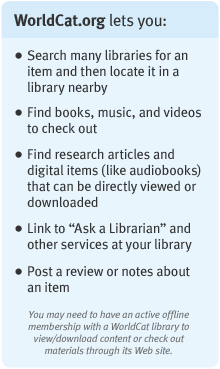 “This site—and a downloadable WorldCat search box you can easily add to your Web site—opens the complete WorldCat database to the public, not just the smaller data subsets utilized by Open WorldCat partner sites such as Google, Yahoo! Search and others. WorldCat.org builds on the success of OCLC’s Open WorldCat Program that has elevated the visibility of library materials on the open Web since the summer of 2003.” (box on left courtesy of WorldCat.org)
What I really liked about this site, besides being able to find many more items in libraries, is that you can search for any item in any library near you, now using keyword searches (i.e., you can enter a title, subject or person). You can also now refine your search (box on left of screen) by author, content, format, language, and year. I am sure that there will be some kinks in it right away, as it is a very new beta site, but I am happy with the direction it is going in now. I look forward to reviews about it after it gets “used a lot” but for now, I like it (and everyone can give them feedback using the link in the top right-hand corner of the results pages).
 By the way, if you do like “finding tools” and sites like this, you might also like to browse my “The Changing Face of the Scholarly Web: Finding Free, Quality, Full-Text Articles, Books, and More!,” published this July/August 2006 in MultiMedia & Internet@Schools magazine. The article is freely available on the Web via their magazine’s main site (which I visit often for its very relevant K-12 library info) and in many of the EBSCO databases now. I do hope you enjoy it and find it useful! And since I was limited to less than 3000 words for the article, here is another site of mine, “WOW!–Full Text AND Free?!!: An Internet Hotlist on Finding Free Full Text Articles and Books” (I used this site to write the article) that lists these and other quality, full-text finding tools, especially with some more of my favorite Open Access (OA) sites. Feel free, please, to share and comment!
Google & MySpace Marriage, & New Social Software Book by Michael Stephens
All over the news sites last night, including Yahoo! News, was the fact that Google and MySpace have signed a $900 million deal “which marries the Internet’s leading search engine with the top social-networking site,” so look for the familiar Google search boxes on the site later this year.
And my personal favorite tidbit of news from Jenny Levine: Michael Stephens’ July/August 2006 ALA LTR “Web 2.0 & Libraries: Best Practices for Social Software” is available for purchase. Jenny says his book “covers blogs, RSS, instant messaging, wikis, Flickr, and getting staff buy-in to implement Library 2.0 tools in your library,” which both Jenny and Michael spoke in length about this recently at their presentation in Princeton, NJ–a fantastic presentation and group turnout. Anyway, I ordered mine a few days ago and it should be here tomorrow–I can’t wait to read it and share the advice with my colleagues, so thanks a lot, Jenny and Michael!
Free AOL – How to convert your paid account
 Heads up–we may be getting questions on this at the reference desk.
AOL is now giving away their service for free. If you’re already an AOL subscriber, but don’t rely on AOL to connect to the Internet, you can switch to the free plan. (If you rely on AOL for actual Internet access, then you’ll still have to cough up some dough.)
Currently AOL is telling customers, “To change your current AOL plan, simply call Member Services at 1-800-984-6207 and select the Billing Option when prompted.” I tried this, and after spending 20 minutes navigating their (gasp!) poorly designed voice-menu, I actually got through to a nice fellow who told me how to cancel. THIS IS BIG SO READ ON…
Although AOL is not really advertising it yet, subscribers can easily make the switch to the free plan by:
- Logging into AOL (log in through their software–sorry, this won’t work through http://www.aol.com/; at least not yet…)
- Choosing KEYWORD: Change plan
- Choosing the option for “Free Plan”
I’ve done it, and I’m here to tell you that it was that easy. A pleasant surprise, especially considering AOL’s well-documented history of making it nigh impossible to discontinue service.
For the first time in many years I’m moved to say, Thank You AOL!
(cross-posted at my new work blog http://sjrlc.typepad.com )
Clickety-Clack, Clickety-Clack
 Just a quick observation and an inquiry for a Friday afternoon.
When we moved in to our lovely new state-of-the-art library a few years back we debated whether we should take with us our one remaining electric typewriter that worked with any sort of reliability. We used to have several typewriters and they were once very popular, but we wondered if we still needed on for public use.
For the last month or so I have been keeping an eye on our one lonely typewriter that is tucked away in a corner on our 2nd floor and am somewhat surprised by the amount of use it still gets. Several times each week I have observed a variety of people of all ages using it for filling out forms, typing letters, and so on. A few people have looked positively relieved when tell them “Yes, we still have a typewriter”. In fact, I find something comforting in hearing the clickety-clack of the keys and knowing that even though we are wired to the hilt with 100+ computers for use by the public we have decided to keep our typewriter for those that still need it or rely on it.
How many other libraries still maintain a typewriter or two for use by their patrons? Is it still in good use or is it collecting dust? I am just curious to see if my observations match those of other libraries.
"The Internet is becoming a cesspool of plagiarism"
OK, maybe we’ve heard this before and it isn’t “news” to us, but I found what was mentioned after this first quoted line from the August 1st USA Today article, “Authorship gets lost on Web” by Del Jones to be very interesting and certainly pertinent to all of us bloggers and other Internet authors. A few of my favorite quotes/info bits from the article are the following:
They’re like cockroaches,” McKee says. “Ideas are our assets, and it’s frustrating when people take them from you without shame,” which referred to bloggers who used McKee’s specific material in their posts without giving him any credit.
“Pew Research two weeks ago said it found that of the 12 million adults who blog, 44% say they have taken songs, text or images and “remixed” them into their own artistic creation.”
As a contributing chapter author for Vibiana Bowman’s 2004 book, I must say that we went to great lengths to ensure that we were giving credit where credit was due in our writings before we published them. It can take some time and effort, but it is worth it.
That being said, I must say that not everyone seems to care about this, and I agree with McKee–it is annoying when we come across our intellectual content found in someone else’s post, online article, PowerPoint slides, or Website–with no attribution given at all. I truly believe that Jones is correct when he states: “In some quarters, plagiarism remains a serious offense. But where it involves the Internet, an acceptance of plagiarism is taking hold, and when confronted, offenders often shrug it off as hardly newsworthy.”
At the end of this short, enlightening article, Jones quotes Berkowitz concerning properly attributing someone’s original content on the Internet: “It’s like the Wild West out there.”
Maybe the Internet, in general, and blogs, specifically, are fast becoming “cesspool[s] of plagiarism,” or maybe not, but you have to admit that you have seen plagiarism on the Web. Let’s not help online plagiarism continue to grow within our own Websites–let’s do our part and remind each other to quote and cite/link to each others’ intellectual property and not let “authorship get lost on the Web.” Yes, even within our own blog postings.
Anyway, thank you, Del Jones, for the stories, quotes, and reminder to honor others. And I hope I gave you and others enough credit–no, really, seriously, I do. To everyone else, read his article.
DOPA Provides Too Little Guidance on Chat & Social Networking
Following up on Janie’s “DOPA Update” post and many others’ on the Web since the speedy approval of DOPA in the House, I want to emphasize again that final approval of DOPA could significantly affect an incredible amount of sites on the Web that allow author and personal profiles and lists, and this includes Amazon.com and many, many blogs. This is because the current version of the bill is too broad and does not define off-limit sites or provide definitions of “chat” or “social networking,” virtually (no pun intended) impacting far too many non-risky, safe sites for children, at least as it is written now. To get you up-to-date on this, again, read the summary article mentioned in Janie’s July 28 post, “Chat rooms could face expulsion,” from CNET News that mentions that this bill will affect at least two-thirds of all libraries. I am all for protecting our youth, as you can read from my July 15 “Social Networking and Online Safety” post, and as everyone is reading now, DOPA does expand on the Children’s Internet Protection Act, which requires libraries to filter sexually explicit material. But, unfortunately, at this time, DOPA leaves much to be desired and provides not much in guidance to the FCC, as you can see from the previously mentioned CNET summary article:
Defining off-limits sites
DOPA does not define “chat rooms” or “social networking sites” and leaves that up to the Federal Communications Commission. It does offer the FCC some guidance on defining social networking sites (though not chat rooms):
“In determining the definition of a social networking Web site, the Commission shall take into consideration the extent to which a Web site–
(i) is offered by a commercial entity;
(ii) permits registered users to create an online profile that includes detailed personal information;
(iii) permits registered users to create an online journal and share such a journal with other users;
(iv) elicits highly personalized information from users; and
(v) enables communication among users.”
Again, I want to say that I am all for protecting our youth being a parent, university professor, and academic librarian myself. But as I have mentioned many times before, I will continually talk about the brighter, creative aspects and rewards of participating in and using social networking sites and many other types of Websites in all of my seminars and face-to-face and online workshops and courses. The current DOPA bill is not the answer, and it will not stop youth and college students from engaging in these attractive online environments. I still think that education is the key. I mentioned near the end of my previous blog article) on this topic several sites that offered practical help. Another I want to mention is the “The Virtual Mystery Tour: A Close Look at Teens, Sex, and the Internet” workshop and its blog. It does not sugar-coat the safety aspect or potential for danger for young Internet users. It does, however, help to assure concerned adults, especially parents, that if their kids have “common sense and they trust them in other ways, they’re probably going to be able to talk intelligently with parents about what they should and shouldn’t do online.”
Parents and other adults seem to be afraid of these social networking sites and tools because many know nothing about them. We as parents and educators need to understand that teenagers (and adults) feel much freer to express themselves online and our youth don’t necessarily understand the potential consequences of “over-sharing.” I think that we need to become more involved and aware of what our teens are doing online, asking them information and making sure that they don’t over-share personal info., letting them know that predators are visiting sites they communicate within, looking for victims.
DOPA is well-intentioned, but it seems flawed as it is now written, and I think that it will negatively affect too many Websites. Making sure that our youth understand the risks & how to avoid mistakes in communicating online, while letting them know that you also understand the positive benefits they reap from the social networking sites, will go a long, long way in building trust and understanding, and help ensure continued education.


 Library Garden