Posts tagged ‘Peter’
Library as Place
 Posted by Peter Bromberg
Note: This piece originally appeared in slightly different form in the NJLA Fall (2006) Newsletter.
We are currently experiencing a unique convergence of three societal trends, and that convergence is creating an unprecedented opportunity for libraries.
The first trend is that people are increasingly using the internet in the privacy of their home for activities that were previously conducted in public spaces. Shopping, banking, conversing, researching, listening to concerts, and watching movies are just a few examples of such activities.
The second trend, pointed out by Robert Putnam in his insightful book, Bowling Alone, is that Americans are experiencing a marked decrease in social interaction as we become increasingly disconnected from our family, from our friends, and from each other.
The third trend is more subtle and presents a threat as well as an opportunity: Businesses are increasingly embracing the value of being a “destination of choice” and modifying their environments and their services accordingly. For example, we used to go to the hardware store to buy grout or drywall; now we go to learn how to tile our bathroom or put up a wall. We used to go to the bank to deposit our checks; now we go to attend a retirement planning seminar. We used to go to the bookstore to buy books; now we go to hear music, drink coffee, and, dare I mention, bring our children to story time…
Our customers have a greater need for shared spaces and social interaction than they ever have before, but they also have more options regarding how, and where, they choose to spend their free time.
LIBRARIES ARE TRANSFORMATIVE PLACES
Libraries are transformative places. By our very nature we offer people a “third place” (not home, not work) where they can come to explore, imagine, think, learn, play, and reflect. Our function as a “third place” has never been more important to our continued health and relevance. If libraries are to survive and thrive we must redouble our efforts and refocus our energies to ensure that we are not only “third places” but destinations of choice.
Thinking of “library as place” goes to the heart of the matter. It invokes the big question: Why would someone in our community choose to spend their time here rather than somewhere else? Related questions might be: What does the library look like, smell like, feel like, and sound like? What do our signs communicate? What kind of environment are we offering to the community and how do library staff contribute to the creation of a friendly, welcoming environment?
The thriving library of 2010 will have thoroughly considered these questions and be guided by the answers they have discovered. Many NJLA members are probably familiar with Mount Laurel Library’s success with their use of retail merchandising techniques. Those techniques were implemented as part of the “Trading Spaces” project. A do-it-yourself kit, replete with documentation, signage, photos, furniture vendor contacts, prices, and more is available at the project website http://www.sjrlc.org/tradingspaces. Taking a look at this resource page is a great place to start if your library is interested in becoming a destination of choice in your community.
SIX THINGS YOU CAN DO TODAY
Detailing a strategic direction for your library is outside of the scope of this short piece. But in the interest of practicality, here are six things you can do today to enhance your library’s status as a true “third place” in your community:
1. DO A SIGNAGE AUDIT: Have everyone on your staff, and maybe a couple of customers, walk through your library with these questions in mind: What makes it easy to find something? What makes it difficult to find something? Are signs readable from a distance? Are signs jargon-free? Do you use Dewey numbers instead of natural language? (Don’t.) Get rid of ripped signs and visible tape. Eliminate handwritten notes. Use positive, respectful wording and avoid parental tones.
2. OFFER FOOD AND DRINK IN THE LIBRARY: (Notice, I don’t say “permit”.) Having food and drink in your library helps create a welcoming environment. The role of our olfactory senses in creating a positive or negative impression of our environment cannot be underestimated. Translation? Coffee smells like comfort.
3. OFFER A VARIETY OF PROGRAMMING FOR DIFFERENT AGES/INTERESTS: This fits in very well with our traditional role and mission, and many libraries already do a wonderful job with programming. Do more. Take some risks. Ask yourself who’s NOT coming to the library and try to offer a few programs for that demographic. Think of five new places to advertise your programming (bulletin boards in laundromats, the Y, the Rotary Club, the carwash, etc.)
4. MAKE THE COLLECTION THE STAR: Use themed displays of face-out materials to highlight and promote portions of your collection. Tie themes in with current events, pop culture, current library programs, or anything else that seems relevant, playful, or fun. Make your collection browseable and your customers will reward you by circulating materials in record numbers.
5. INVOLVE YOUR CUSTOMERS: Ask your customers what they would like to see in the library. Ask them for help with walk-throughs and signage audits. Ask them for display ideas, or enlist their help in creating displays. Any way you can involve your community directly will pay off tenfold by giving you an inexpensive and highly effective marketing tool: a cadre of invested community members who will promote the library through word of mouth.
6. GO WIRELESS: Wireless Internet access is a must-have infrastructure. If you’re not offering it already, do it now. It’s cheaper than you think, and your wireless customers will come out of the woodwork.
Bibliography
Oldenburg, Ray. The Great Good Place. New York: Marlowe & Company, 1999.
Rippel, Chris, “What Libraries Can Learn from Bookstores”. Webjunction Marketing Forum. Dec 10, 2003 <http://webjunction.org/do/DisplayContent?id=1191>.
Rockwood, P. E. and Koontz, C. M., “Media Center Layout: A Marketing-Based Plan”, School Library Media Annual 1986, Volume Four. Ed. Aaron, S. L. and Scales, P. R. Littleton, Colorado: Libraries Unlimited, Inc., 1986. p. 297-306 <http://www.geolib.org/pdf/slma.pdf>.
Stanley, John, “The Third Place: The Library’s Role in Today’s Society”, MLS Marketing Library Services. Nov.- Dec. 2005: 1,8.
Blog-based library websites: An interview with David Lisa
 I recently sat down with (ok, meebo‘d) David Lisa, Director of the West Long Branch (NJ) Public Library, to discuss how he recently converted his traditional library webpage to a blog-based webpage.
Pete: Thanks for joining me this afternoon.
Dave: Always a pleasure!
Pete: For starters, tell me a little about yourself and your library.
Dave: My name is David Lisa and I am the Director of the West Long Branch Public Library. We are a small municipal public library. West Long Branch has about 8700 residents. We have three full-time employees and 7 part-time, 3 pages (PT) and one volunteer. I’m the only professional on staff. Other than that, we are your normal small burg PL.
Pete: Thanks Dave. So tell us a bit about your decision to make your webpage blog-based.
Dave: I had worked on several different templates for the new version of our website and nothing was working. Then I attended the Web 2.0 seminar led by Michael Stephens and Jenny Levine and took what the speakers said to heart. It really seemed to me that if we started with a Blogger.com format and expanded upon that, we would be able to accomplish what we wanted to do. Namely to be able to give our users news about programming, spotlight our collection and keep them up to date on new additions to our collection. It also dawned upon me that we could utilize Blogger’s template structure to organize our website by listing the links to the various pages on our site in the right column and be able to provide an archive etc. It did everything we needed! So, I set to work setting it up, then “adapted” our extant pages to the Blogger template format.

Pete: Yes, the built-in archive feature is wonderful. Are there any other specific benefits that you see with a blog-based website? Any drawbacks?
Dave: Well we are getting lots of great comments about how up to date our site is. People really like seeing the latest news on the front page in reverse chronological order. And, of course, one big benefit is being able to offer an RSS feed through Feedburner. We like to stress that we can bring the news about the library to you on your schedule rather than you having to come to us all the time. One drawback has been that we have found that not a lot of people are acquainted with RSS feeds and we have to explain how to subscribe a lot.
Pete: That leads into my next question (or series of questions): Do you find that your customers understand the RSS feed? Are they using it? Have you done anything to promote the feed and/or teach your customers how to use it?
Dave: As I mentioned, there is some confusion about RSS still. I see that as being general initial confusion amongst the public at large. We really wanted to get the feed through Feedburner since they do a good job explaining it. We are pleased to have the feed in place and are actually waiting to see how it works out…right now.
Pete: Well, I think you’re ahead of the curve. I believe the next release of IE will have built in RSS detection and reader. At that point, knowledge and use of RSS among the general population is likely to grow quickly and exponentially.
Dave: That’s a good example of the confusion…try setting up an RSS feed with Firefox and IE and it’s a different experience. We wanted the user to be able to click through the experience and know little about what they had to do to make it work. Feedburner does a great job enabling that.
Pete: And of course Feedburner gives you great stats and bunch of other nice benefits!
Dave: Feedburner has a nice page that you get after you click on our Subscribe link and it explains the variety of choices of RSS readers.
Pete: How much technical ability is needed to create a blog-based website? Is it something anyone can do or is a certain level of technical know-how necessary?
Dave: Good question. I believe that the approach we took to revamping our website takes little web publishing knowledge and could be mounted by people with little experience. And I think that is the direction web publishing is taking. Jenny [Levine] and Michael [Stephens] mentioned that web publishing software (Dreamweaver, FrontPage, etc.) will be outmoded by this approach soon… and I believe them.
Pete: Well, Blogger, Typepad, WordPress really make it easy!
Pete: I see you have multiple authors. Who gets to post, and what do they get to post about? Did you and your staff come up with a blogging policy?
Dave: Glad you asked that question. From the get -go, I wanted our library website/blog to be a collaborative effort. I met with my Administrative staff and indicated that since we were re-creating the website in this fashion, I wanted them all to be involved. I also involved key members of the part time staff too (Book Discussion group moderator, etc).
Pete: That’s great!
Dave: I also wanted staff members that are posting to be recognizable by name to library patrons that read the blog and could answer questions. We crave a fandom. [smile]. This is a truly collaborative experience.
Pete: I salute you! The research going on in virtual reference shows that customers really like to have a name associated with the librarian (as opposed to being served by ‘librarian34’). Using names is a great way to bring about more of a sense of personal connection.
Dave: I wouldn’t have it any other way…I want it to be a personal experience for the user. We want to hear this: “Wow, Janice recommended the new DVD Lucky # Slevin. I checked it out and I loved it. Thanks Janice!”
Pete: OK, since we’re on the topic of collaboration… It doesn’t look like you have comments enabled. Any plan to enable comments?
Dave: We purposefully disabled it for now. We do have plans to enable them at some point, but we want to plan for it so we can handle it correctly.
Pete: Well Dave, I think you’ve done a great job with the site, and I appreciate you taking the time to share your experience with us. Is there anything you’d like to add before we conclude?
Dave: I’d just like to say that we actually stumbled upon this idea by accident, and it was all due to the seminar… so thanks for sponsoring it. We’re always looking for new and different ways to do things here at WLBPL and we are having lots of fun with the website/blog.
Pete: Credit for sponsoring the seminar goes to Princeton Public Library and CJRLC (although we also had Michael Stephens present for SJRLC members that same week.)
Dave: Thanks for interviewing me!
Pete: You’re welcome Dave. Thanks again for your time.
Wikipedia v. Britannica: This time it’s personal
 Get thee over to the Wall Street Journal and read this gloves-off (you know, in a genteel way) debate between Jimmy Wales, founder of Wikipedia, and Dale Hoiberg, editor-in-chief of Britannica. Here’s a taste:
Mr. Hoiberg: No, we don’t publish rough drafts. We want our articles to be correct before they are published. We stand behind our process, based on trained editors and fact-checkers, more than 4,000 experts, and sound writing. Our model works well. Wikipedia is very different, but nothing in their model suggests we should change what we do.
Mr. Wales: Fitting words for an epitaph… …We are open and transparent and eager to help people find criticisms of us. Disconcerting and unusual, I know. But, well, welcome to the Internet.
Personally, it took me a while to get to the point where I feel a fair level of trust in the quality of Wikipedia. I think Wales has done an excellent job of creating a system that maximizes the benefits of open source collaboration, while minimizing the drawback and dangers of having too much openness. I’m reminded of the brilliant article Clay Shirkey wrote a few years ago, “A Group is it’s own worst enemy“. Shirkey, building off of the concepts expressed by psychologist W.R. Bion in his seminal work,”Experiences in Groups“, wrote,
Group structure is necessary to defend the group from itself. Group structure exists to keep a group on target, on track, on message, on charter, whatever. To keep a group focused on its own sophisticated goals and to keep a group from sliding into these basic [destructive] patterns. Group structure defends the group from the action of its own members. (emphasis is mine, pjb)
I remember being struck by Bion’s work when I first read him in a college psych class, but Shirkey really brings it home. Although Shirkey is mostly focusing on social software, the concepts expressed in “Own Worst Enemy” are applicable well beyond that topic, and you might find yourself reflecting on the structure and health of your library (or your Bridge club, or your — um, make that OUR — government). Geek confession: I keep a copy of Shirkey’s article in a “Ponderables” binder on my night table and re-read it regularly.
But I digress. Point is, Wales has done a great job of keeping Wikipedia from being it’s own worst enemy, and I’ve seriously warmed up to Wikipedia as a trusted source.
Is virtual reference successful? Part II (Hint: yes it is)
 In Part II I’d like to respond specifically to two comments. The first is from Morgan Fielman. The second from Pascal Lupien, author the article I’m discussing.
RESPONDING TO FIELMAN
Commenter Morgan Fielman wrote, “The original poster seems to have missed the point of this article, which is primarily about software.”
No, I get that the point of the article is primarily about the software and not the customer experience. But the article is so broadly written and lacking in detail that it ends up saying nothing more specific than “VR software has problems.”
My questions, unanswered by the article are, What software? What problems? Two of the products Lupien writes about (Tutor.com’s and QuestionPoints’) recently underwent complete overhauls, in effect becoming completely new products. It is unclear from Lupien’s article which versions he’s writing about but my sense is he’s writing about the older versions. If that’s correct then most of the article is, at best, moot.
Granted, the larger issue of whether or not the software is effective is a valid issue that warrants exploration and discussion. Fielman goes on to ask, “but how can customers be satisfied when the software we use is so poor?” I say that’s the wrong question. The question is “Are customers satisfied?” The answer in our customers’ experience is yes, they are satisfied. We didn’t find this out by polling 20 libraries. We found this out by asking the customers. Another good question might be, “Do the problems with VR software affect the quality of the customer experience, and if so how and to what extent.” There are many people at collaborative VR services looking at a lot of data to answer that question. Lupien’s article suggests that problems with software affect the customer experience but offers no actual data to back it up. He mentions problems with popup windows, problems with Windows service pack 2, and problems with serving customers who use Macs, but he is not specific about which software products exhibit which problems and to what extent. And again, Lupien is not clear which version of Tutor and QuestionPoint he’s talking about. The newer versions of both products are compatible with Mac users, and have no problems with service pack 2 issues that I’m aware of.
Fielman concludes his comment by saying “original VR supporters have realized that this service just isn’t cutting it.” The fact is our service has been cutting it for almost 5 years, and we have the hard data and glowing customer comments to prove it. If your VR service isn’t cutting it, you need to ask why. Are your staff trained on the software? Are they enthusiastic? What are you customer service standards? Do your librarians give kick-ass customer service in f2f encounters? What quality control mechanisms do you have in place? Do you examine your transcripts for quality? Do you have regular and convenient service hours? Are you available 24/7? (going 24/7 made a huge difference in our usage, even though usage mostly grew during hours we were already open — go figure…) And finally, but certainly not last, do you consistently and effectively market your service to your customers? Do they know you exist???
If your service ain’t cutting it maybe you need to answer these questions first before blaming the software, which is an easy way out. Consider that here in New Jersey using standard VR software (currently QP, formerly Tutor/LSSI’s eGain-based software) we’re cutting it and then some. Other statewide collaboratives are doing quite well too. And we’re all working very diligently with our respective vendors to ensure that our VR platforms are stable and highly functional. While the current glitch here and there can be a real and undeniable pain in the ass, it hasn’t prevented us from delivering a high quality and slightly mind-blowing experience to our customers.
RESPONDING TO LUPIEN
First, I’d like to thank Pascal Lupien for taking the time to offer an extremely well-written and thoughtful comment in response to my first post. I’d like to assure him that contrary to his assertion, I’ve read his article through thoroughly a few times. I have no problem with bad news about VR. I just want accurate and somewhat substantiated news. I’m offering up the reality of my experience at QandANJ to counter the broad statements that Lupien makes. Now to some of his specific comments.
He writes, Perhaps these results aren’t what proponents of VR would prefer to hear, but they do represent a problem that needs to be discussed, for the sake of our users.
I do not consider myself a proponent of VR, I consider myself of proponent of libraries. It is my desire that libraries remain relevant to our customers by offering a suite of high quality services. Collaborative VR is one such service, offering our customers 24/7 access where and when they want it. I want to see libraries changing their customers’ perceptions about what libraries can offer them. I want libraries to blow customer expectations out of the water. I want libraries to be around in 50 years. It is not that I don’t want to hear bad news about VR software. I’m perfectly open to hearing about the problems with the current stable of VR software offerings. It’s just that I want to hear facts, not conjecture. And I want those facts to be couched in some meaningful context and always tied back, to whatever extent possible, to the impact on our customers. I didn’t get this from Lupien’s article.
Lupien writes, To respond to the person who claimed that software is the last thing that matters about VR, I say tell that to the user who is unable to log in because she uses a Mac, or because her computer has pop-up blockers. Tell that to the user who is “kicked off” in the middle of a session because the VR software does not function properly with the library’s licensed databases. These things happen regularly, and this article makes an attempt to discuss them.
I’m pleased to see Lupien talking directly about the impact on customers. Clearly we agree that it would be optimal if VR software worked across all platforms, had no problems with pop-up blockers, and worked 100% of the time so no user was ever “kicked off.” I am not suggesting that these problems don’t exist, I am asking to what extent do they exist, and to what extent do they impact the customer’s experience and satisfaction with VR service. Because Lupien fails to identify what versions of the various VR products he tested, and is repeatedly non-specific regarding his data, the article fails to answer these questions.
Lupien grants that, “many regular VR users appreciate the service,” and that he wasn’t contesting that fact. Our experience suggests that it is not “many” but most.
Lupien writes, “Shouldn’t we be thinking about these potential users as well, rather than focusing on those who already use and appreciate the service? Shouldn’t we be trying to determine if one software product could help us to improve the experience for all users, not merely the satisfied ones? Perhaps some would fear doing this, as it would reveal that their VR service isn’t as successful and user-friendly as they like to claim?
Yes, we should absolutely be thinking about our potential users, and we should always be shooting for a platform that will provide high quality service to everyone. Again, it’s a matter of facts and context. Lupien’s article disappoints me on both counts.
Lupien writes, “The point of this article is to focus on users who are unable to log in to begin with, who encounter technical problems during a transaction, or who choose not to use the service because they would be required to disable pop-up blockers or use a particular browser, etc. We’ll never know how these users feel about VR, because they don’t get far enough into a VR transaction to make…comments.
Actually, we have some way of knowing. We ask. Yes sir, right there on the front page of QandANJ we say, “Click here to give us feedback on how our new software is working for you.” Here’s a sample of what we find: Since May 1st (79 days), we have received 23 comments. 16 of them were specifically technical (some were positive, some were of the nature, “it wasn’t fast enough”.) One comment came from a Mac user, 3 came from customers accessing us through the AOL interface and browser. So Mr. Lupien, we do make an effort to compile and monitor such information, looking for problematic trends with an eye on improving the service.
Finally, Lupien suggests that I have not been keeping up with the VR literature and if I had “taken the time to consider some of the issues discussed in this article before jumping on that user-centric high horse” I would have “come away with a better understanding of what is happening beyond QandANJ.”
I can assure Mr. Lupien that I keep up quite well with VR literature thank you, and I’m familiar with Coffman and Arret’s article, which you can read here (right at the bottom of the page, after Brenda Bailey-Hainer’s reasoned response.) And if speaking from a place of fact and experience instead of conjecture and generality puts me on a high horse then what can I say? Giddyup.
In Part III (much shorter, I promise) I’ll address the VR software versus IM question.
Epilogue: Customer comment from today: “I am exceedingly impressed. First time in ages I felt like I was getting something positive for my tax dollars.” (Our funders sure hate to see this… Ha Ha )
Is virtual reference successful? Part I (Hint: yes it is)
 Pascal Lupien begins his recent article on virtual reference (Virtual Reference in the Age of Pop-Up Blockers, Firewalls, and Service Pack 2 , By: Lupien, Pascal, Online, Jul/Aug2006, Vol. 30, Issue 4) “by declaring that, “the evidence indicates that libraries are not satisfied with the service.” Say what? Aside from the fact that the statement is so overly broad as to be false on the face of it (which libraries? which services?), it’s not about whether the libraries are satisfied with the service, IT’S ABOUT WHETHER THE CUSTOMERS ARE SATISFIED WITH THE SERVICE.
The fact that Lupien goes on for nearly 3500 words with nary a mention of customer satisfaction epitomizes to me the worst of librarian-centric thinking at the expense of customer experience. 3500 words with:
- No mention of how VR customers love and rave about the convenience of the service.
- No mention of how VR customers love and rave about having a live person available to assist them with their information needs.
- No mention of how VR has changed our customers’ perceptions of what libraries can offer them.
- No mention of how VR has helped make libraries more relevant to our customers by meeting their needs and exceeding their expectations.
I am feeling weary after reading Lupien’s article. Weary because there is so much wrong with it that it almost demands a line-by-line critique in the spirit of Twain on Fenimore Cooper. Well Lupien isn’t Fenimore Cooper and I’m certainly not Twain, and besides I’m really, really tired.
So let me address a few errors, raise a few eyebrows (two, to be precise) and share some of my own experience – uh, make that our customers’ experience – with VR via QandANJ.
A moment to share my creds: I’ve been involved with QandANJ since it’s inception in 2001 (before that, actually,) helping to build, manage and promote the service. I’ve looked at thousands of transcripts and thousands of customer feedback forms. I know that our usage is through the roof. We handle as many “calls” as we can limited only by our ability to offer deeper staffing. I know that our customers tend to be very satisfied, and I know WHY our customers tend to be very satisfied. If you want to delve deeper into our stats and findings, take a look at this presentation from the VRD Conference in 2003. (there’s more here) The numbers may be a little dated, but the story they tell and the trends they point to remain just as true today.
I’m not making this stuff up… Here’s one of my favorite comments:

If you think this is cherry picking, it ain’t. We get our share of negative comments too (usually younger users, usually wanting “faster, faster, faster” service.) The reality is our customers are happy. Why? Here’s what they tell us:
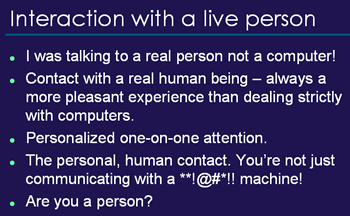

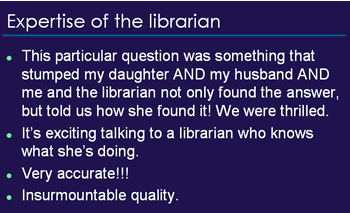
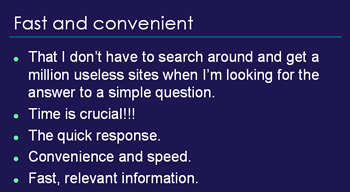
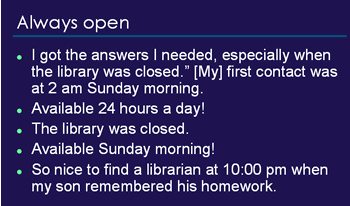
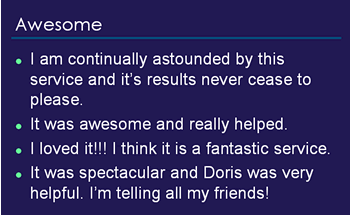
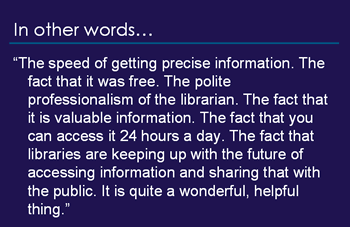
We have hundreds of pages of single-spaced pages with thousands of comments that go on and on in these veins. There are many other successful collaborative VR projects like those in Maryland, Colorado, and Cleveland that could show you similar comments from their satisfied customers. The challenge isn’t attracting the customers, it’s managing to grow the staffing of the service to keep pace with the demand!
In part 2, I’ll get a bit more nit-picky with other elements of Lupien’s article.
Dogmas Are Meant to be Broken: An Interview with Eric Reiss – Boxes and Arrows: The design behind the design
A little Friday lunchtime reading… If you like the Dogma, follow the link and read the interview with Reiss. I’m going to be re-evaluating mpow’s website with these 10 points in mind.
——————————————————————–
From: Dogmas Are Meant to be Broken: An Interview with Eric Reiss – Boxes and Arrows: The design behind the design:
“Web Dogma ‘06”
1. Anything that exists only to satisfy the internal politics of the site owner must be eliminated.
2. Anything that exists only to satisfy the ego of the designer must be eliminated.
3. Anything that is irrelevant within the context of the page must be eliminated.
4. Any feature or technique that reduces the visitor’s ability to navigate freely must be reworked or eliminated.
5. Any interactive object that forces the visitor to guess its meaning must be reworked or eliminated.
6. No software, apart from the browser itself, must be required to get the site to work correctly.
7. Content must be readable first, printable second, downloadable third.
8. Usability must never be sacrificed for the sake of a style guide.
9. No visitor must be forced to register or surrender personal data unless the site owner is unable to provide a service or complete a transaction without it.
10. Break any of these rules sooner than do anything outright barbarous. “
Friday Fun: The I/O Brush
It ain’t new but it’s new to me–and just the friday fun I needed to ease me into the weekend. Enjoy!
Direct Link: http://www.youtube.com/watch?v=Hu1_SJB4YLU
More info at: http://web.media.mit.edu/~kimiko/iobrush
Catching Up
 Been super busy lately. Superer and busier than usual even such that I haven’t found the time (ok, let me own this, haven’t made the time) to comment on some really amazing posts out in the blogosphere. Here’ s a sampling of what’s been blowing my mind lately, some old, some new. My intention is to write more fully on all of this soon. I’ve added these to a new “must read” section on the sidebar of the blog.
- Karen Schneider’s “The User is Not Broken”
The most significant help you can provide your users is to add value and meaning to the information experience, wherever it happens; defend their right to read; and then get out of the way.
Your website is your ambassador to tomorrow’s taxpayers. They will meet the website long before they see your building, your physical resources, or your people. - Darlene Fichter’s thoughts on “Radical Trust”
Radical trust is about trusting the community. We know that abuse can happen, but we trust (radically) that the community and participation will work. In the real world, we know that vandalism happens but we still put art and sculpture up in our parks. As an online community we come up with safeguards or mechanisms that help keep open contribution and participation working.
- Wandering Eyre’s “Why my OPAC Sucks”
3,11,15) It will not correct my bad spelling8) If I do not type “U.S. News and World Reports” in exactly that fashion with the periods and spaces, my OPAC thinks we do not have this item
16) With all my practice and training, sometimes I can not find things I know we have, how can I expect my users to find anything?
- John Blyberg’s “ILS Customer Bill of Rights”
I envision a library Bill-of-Rights with four simple, but fundamental must-have’s from your ILS.
1) Open, read-only, direct access to the database.
2) A full-blown, W3C standards-based API to all read-write functions
3) The option to run the ILS on hardware of our choosing, on servers that we administer
4) High security standards - Karen Schneider’s “How OPACS Suck Part 3: The Big Picture”
The fundamental problem with today’s library catalog is that it suffers from severe literalism. Even with a few bells and whistles, today’s OPAC is a doggedly faithful replica of the card catalog of yore. This isn’t a failure of any one vendor; by and large they’re delivering what librarians think they want. It’s a larger failure of vision.
- Karen Schneider’s “How OPACS Suck Part 2: The Checklist of Shame”
But think about your own catalog: are these features available? It may well be, as some users wrote me privately, that the OPAC (as separate software purchased by local libraries) is near death’s door. I think that’s very likely. But if so, anything else we use for a catalog—who’s betting on Open WorldCat?—will need good search functionality as well, or it too will suck, only more consistently and on a much larger scale. In the end, as uber-librarian and user champion Marvin Scilken told me many times, the bottom line is public service.
- Karen Schneider’s “How OPACS Suck Part 1: Relevance Rank (Or the Lack of It)”
The users who complain that your online catalog is hard to search aren’t stupid; they are simply pointing out the obvious. Relevance ranking is just one of many basic search-engine functionalities missing from online catalogs. NCSU worked around it by adding a search engine on top of its catalog database. But the interesting questions are: Why don’t online catalog vendors offer true search in the first place? and Why we don’t demand it? Save the time of the reader!
- Dan Russell’s “Getting People to Decide”
Here’s the bottom line: Be specific in your help and support. Be very clear. And get your users to decide to do something with your product. Don’t let it just lie there and go out of their attention—get your users engaged!
Thoughts on ALA Bootcamp: An L20 Manifesto

Some of you may be following the conversation going on concerning ALA’s Library 2.0 Boot Camp. (If you want to catch up, read here, here, here, here (audio here), here, here, here, here and here).
I am a participant in the workshop, and I see the conversation that’s playing out as one big, (public) demonstration of the power and value of L20. There are both positive and negative examples for us to learn from here. My working group in L20 Bootcamp has been charged with answering the question: “How can Library 2.0 be used to enhance [ALA] membership?” What follows is my response.
First, a few thoughts:
I understand the Otter Group’s motivation to defend themselves against perceived attacks. I believe they set out to do good with this workshop. I’ll grant that their motivations are pure. I imagine they must be feeling a bit like “no good deed goes unpunished.” Having said that, I think their evolving response to the criticisms being levied at them could have been plucked whole-cloth from the ClueTrain Manifesto, under the heading, “What not to do” or “Example of corporation 1.0 in its’ death throes.” That is to say, while running a course that is, at its heart, about having conversations, they are investing time and energy and (allegedly) using the language of intimidation and threats of legal action to stamp out conversation because they don’t like what’s being said.
This is great!!! It’s great because it offers us a real-time, unfolding case-study, ripe with lessons we can sink our teeth into. I do not see this as a simple case of the big bad corporation versus the noble defenders of good. It’s a little more nuanced than that (most things are, right?). To the extent that we can resist our impulses to cast this as a drama of good v. evil, we can extract some useful lessons.
That I am getting value from my Bootcamp experience and the conversations that have sprung up around it is unquestionable. As far as I’m concerned, the fact that ALA is doing anything is a huge overriding value. I’m aware that much of the value I’m extracting as a participant is because of Otter’s (and Jenny Levine’s and Michael Stephens’) contributions. And some of it is in spite of their contributions. Right now people are talking about the “in spite” part. That’s ok. That’s natural. That’s healthy. But it’s not the whole story. What follows is my attempt to frame what I’m seeing, hearing, reading, and experiencing in a way that will help me learn and extract value from this experience. Nothing more, nothing less.
El Tuo’s L20 Manifesto: (Thoughts on using L20 to enhance membership in ALA
- L20 is a conversation.
- Don’t try to put the conversation in a box.
- Conversations do not occur in boxes.
- Conversations are organic. They go where they go. They grow where they grow.
- The further a conversation goes the better. The wider it grows the better.
- Go where the conversation goes or you will cease to be a part of it.
- No one controls the conversation.
- If you try to control the conversation, it will affect how others perceive you in spite of anything or everything else you are doing.
- If you try to control the conversation, you will lose credibility (at best).
- Credibility is the coin of the web 2.0 realm.
- If you try to control the conversation, you will ignite and draw peoples’ anger or ridicule or both (if you’re lucky).
- Your response to anger and ridicule can be a part of the conversation or separate from it, in which case it is simply prologue to your epitaph.
- If you try to control the conversation you will be ignored as irrelevant (at worst).
- Irrelevance is worse than death. People say nice things about the dead, but the irrelevant are seldom mentioned.
- Anyone can participate in the conversation.
- We add value by participating in the conversation.
- It is the quality of our participation, not the quantity, that determines how much value we bring to the conversation.
- We extract value by listening to the conversation.
- The best listeners extract the most value.
- The organization that listens best extracts the most value.
- Organizations can’t just listen… They must participate.
- ALL feedback is good.
- Conversations flourish when ALL feedback is seen as good.
- All feedback is useful.
- Conversations flourish when ALL feedback is seen as useful.
- The appropriate response to feedback is to say thank you.
- Find another way to say thank you.
- Repeat.
- Now offer a thoughtful response to feedback.
- Congratulations, we are now having a conversation.
(This manifesto has been cross-posted to: http://eltuo.pbwiki.com/ I encourage fellow boot camp participants and anyone else interested in growing the manifesto to jump in and edit. The pwd is eltuo.)
————————————–
EDIT: This was written and posted before reading Michael Stephen’s latest post at Tame the Web–really! A little bit of sychronicity…
Scan this post

Kevin Kelly’s NY Times Magazine article, Scan This Book, blew my mind. I read it straight through on Sunday and have re-read selected snippets a few times trying to wrap my mind around the implications. Here are a few selections that really jumped out at me (with my comments if I rally the brain cells to assist me.)
Kelly writes,
The link and the tag may be two of the most important inventions of the last 50 years. They get their initial wave of power when we first code them into bits of text, but their real transformative energies fire up as ordinary users click on them in the course of everyday Web surfing, unaware that each humdrum click “votes” on a link, elevating its rank of relevance. You may think you are just browsing, casually inspecting this paragraph or that page, but in fact you are anonymously marking up the Web with bread crumbs of attention. These bits of interest are gathered and analyzed by search engines in order to strengthen the relationship between the end points of every link and the connections suggested by each tag. This is a type of intelligence common on the Web, but previously foreign to the world of books.
Mind blow the first: Simply by clicking on a link we are affecting the order the of the web. What seems to be a “read” action, turns out to be more of a “read/write” action. The more we click on something, the more likely it becomes that someone else will find it and click on it.
Kelly writes,
Once digitized, books can be unraveled into single pages or be reduced further, into snippets of a page. These snippets will be remixed into reordered books and virtual bookshelves. Just as the music audience now juggles and reorders songs into new albums (or “playlists,” as they are called in iTunes), the universal library will encourage the creation of virtual “bookshelves” — a collection of texts, some as short as a paragraph, others as long as entire books, that form a library shelf’s worth of specialized information. And as with music playlists, once created, these “bookshelves” will be published and swapped in the public commons. Once snippets, articles and pages of books become ubiquitous, shuffle-able and transferable, users will earn prestige and perhaps income for curating an excellent collection.
Mind blow the second: Individual enthusiasts writing, selecting, “curating”, mashing, may soon be on an equal footing with the “experts.” I can already see this happening with wikis and blogs. The truth is, I now get almost zero useful information from our professional literature (It takes me about 10 minutes to read American Libraries and/or LJ.) But I get an immense amount of useful and stimulating information –information that is helping me do my job better– from a number of library and marketing blogs that I read regularly with the the help of RSS. (So how long before we hear, “Dude, have you heard my mashup of Federalist #51 and the new Neil Young album? Publius rocks!!)
And there’s more. A lot more.
- The sorry state of our copyright law, and the black hole of out-of-print information it has created (sucking, sucking, sucking information away from the public domain.)
- The fact that a large % of out-of-print info can’t be put back into print because, well, because no one even knows who owns the copyrights.
- The possibility that Google can bring much of this “lost” information back into play by scanning and indexing it, thereby shifting the onus to copyright holders to exert claims (if they have them.)
- The filtering power of hyperlinks and tags to bring items that exist out on the long tail to peoples’ attention. (think: If you like Ryan Adams, you may like the Jayhawks, and if you like the Jayhawks you may like, Uncle Tupelo, and if like Uncle Tupelo, you may like Calexico, and if you like Calexico you may like Giant Sand, and if you like Giant Sand, you may like their album Glum (and that’s about as long tail as it gets.)
I’ll be re-reading this piece, and reading other blogger’s thoughts on it, trying to flesh out and extrapolate what it all means for libraries. It occurs to me that the Overdrive audiobooks platform already allows us to add our own pdf and audio content to the collection. Will librarians soon be performing more local collection development of digital formats?
The possibilities (and challenges) of adding exponentially more community created content (like Atlantic City’s teen poetry slam, or flickr photo sets, or autobiographies) as permanent additions to the collection is intriguing!


 Library Garden