Facebook and Updating the Stereotypical Librarian Image
I hope everyone enjoyed our hosting of the Carnival of Infosciences and the post a few days ago–special thanks to Janie Hermann for running the show on this for Library Garden. Submitting to the Carnival was fun, although I probably should have limited myself to just one or two of the best posts, but there was so much good “stuff” out there to talk about.
One topic I just loved reading about deals with networking with our students online. I promised in an earlier post that I would come back to this, and today is specifically about Facebook (the summer session is starting at Rider University and some of the students are already communicating with me, even only in quick questions or just in “pokes.”) One of my colleagues at Rider, our fairly new business librarian Diane Campbell, was talking to me about connecting better with our freshmen and graduate business students. We were brainstorming on bringing the library to them, promoting our resources and services. So, I mentioned Facebook, which seems to be pretty hot at Rider. OK, if you don’t know what I am talking about, you must read Brian Mathews’ “Do You Facebook?” article from the just-picked-it-up-from-my-mailbox May 2006 issue of C&RL News (page 306-7). I really appreciated Brian’s take on using Facebook at the Georgia Institute of Technology. Here are some highlights from the beginning of the article for those interested in proactively promoting the library and/or your subject specialty area:
During my time on the reference desk, I discovered many gaps in students’ familiarity with the library. Could the popularity of Facebook be used as a marketing tool? I started by searching within the Georgia Institute of Technology directory on Facebook for the keyword “library” and discovered Sleeping in the Library, a community group whose members share their favorite locations to take a nap. Next I searched globally and found that a handful of other libraries had created profiles.
We all need to see if we have sleeping communities where we work!
Reading further into this “Reaching out” section, Brian mentions that he wanted to be “proactive” but to appear as himself, “rather than a faceless organization.” I totally agree with him on this point. I understand the desire to create a Facebook library community to “push” out information to our students, and I will probably do that, but for now, interacting with our students in this natural environment as a professor-librarian seems to work well.
Anyway, Brian briefly talks about his “plan,” the “payoff” of immediate responses after setting up his account and delivering some messages and photos, and the future of his use of Facebook to reach out to their students at Georgia Institute of Technology.
By using online social networks, librarians can increase campus visibility and update the stereotypical image, but, most importantly, we can let students know what the library is really all about.
Nice job on that, Brian!
Save the Date — if you are in NJ (that is)
Michael Stephens and Jenny Levine are coming to New Jersey!
They will be presenting Conversation, Community, Connections, and Collaboration: Practical, New Technologies for User-centered Services (aka the 4C s roadshow) on July 18th at Princeton Public Library. The workshop will run from 9:30 am to 2 pm and include lunch.
Final cost and registration details to be forthcoming very soon… just wanted to start spreading the word so that calendars can be marked! If you are a NJ blogger, please cross-post and promote… tell your colleagues that this will be an event not to be missed.
I am off to Canada for a 10 day holiday and will update when I return.

Carnival of the Infosciences — On with the Show!
 It has been a busy week at the Carnival grounds. Make sure you have plenty of pocorn and candy floss (aka cotton candy) and a large cup of soda before the show begins as you will need it. Prepare to be amazed and dazzled by the participants in edition #38 of the Carnival of the Infosciences. Without futher ado… on with the show.
We started with a very early submission from David Bigwood of Catalogablog who stated “this is one of the best ideas I’ve seen in quite some time: Noting donations and donors in the OPAC”. We here at the Library Garden agree that this is a fantastic idea.
Next in to the ring was was Ellysa from Infotangle who not only complimented us on the concept of the Library Garden (in her words: “I think it’s a wonderful idea to form a blog which embraces a multitude of perspectives written by librarians of different backgrounds”) but also pointed us to her post on Community 2.0 in which she defines several types of communities and gives some great examples of community in practice. Well done Ellysa and thanks for the compliment.
Ellysa was quickly followed by Bill Drew (Baby Boomer Librarian) linking us to his post Verizon giving information to NSA – My response. Bill remarks: “This started up my interest in the NSA and records of phone numbers I call.”
After a brief intermission, we had Rick Roche asking for us to please consider his look back at the 1979 ALA Annual Conference meeting on government documants for the carnival. He comments in the post on how some concerns are the same though the technology has changed. A very interesting trip back in time and well worth the look!
Next in to the fray came Filipino Librarian who clearly feels that it is not enough to complain about the existence of librarian stereotypes and believes that “alternative images must be presented” and thus he submits his post, “I am a Librarian” for our reading and viewing pleasure. He also had an addendum to his entry in which he states “I just found out that there was a bit of a discussion last month about self-promotion. I guess this post falls under that category… but in a different direction 🙂 ”
Anali from Grumpator gave us a thought-provoking summary of two talks she heard this week given by Joan Frye Williams.
And then we finish off the show the same way we started — with an entry from David Bigwood who says: “I have never sent in a second submission for a week, but here I go. A couple of library students have created a tool, ClaimID, that has been getting good press in the Web 2.0 community but none in the L20 arena, that I’ve seen. ”
We also got a P.S. from David Bigwood that contains a cool idea. David says: “Bootcamp sounds fun. What we need is a L20 and Web 2.0 conference. Get the folks from Digg, 37 signals, Amber McArthur, Leo Laporte together with Dan, Jenny, Steven et al. Now that would be one I’d not miss. ” We here at LG wouldn’t want to miss it either. Who wants to be on the organizing committee and get this conference off the ground?
Now for our picks of the week from the bloggers on Library Garden (we have a lot of editors, so we have a lot of picks):
We liked “It’s all ‘me'” from Library Marketing where Jill Stover talked about an WSJ article author who “predicts that consumer power will shift increasingly toward individuals who will declare what it is they want and marketers will be tasked with listening to and addressing those needs.” We think Jill is right on the money when she suggests that “we [in the libraries] design and deliver our services [while being] proactive in listening for and addressing needs, and that we’ll have to work very closely with patrons to provide customized services at their times and places of need.” Very thought-provoking, both her blog response and the article itself.
Ricklibrarian caught our attention when he wrote about using Google Notebookfor Nonfiction readers’ advisory. He created a sample notebook with links and text which he links to. Being able to bring all that information together easily and then having it available from any computer anywhere is just brilliant.
Best Sellers, Best Borrowed, Most Collected posted at Stephen’s Lighthouse was also selected as a pick as it offers up another puzzle for the ages: Why do libraries insist on promoting bestsellers when it inevitably leads to frustration for users who then find themselves number 579 on the hold list forthe book?
Another fave was Ten Months In by Laura S. at Library Crunch talking about the Library 2.0 discussion, and where you can listen to her article. Here is the quote that really got our attention: “We now have a clear, yet fluid definition [of Library 2.0]: user collaboration, constant and purposeful change, and reaching the long tail. Librarians from around the world are discussing this concept. It is a topic at conferences, courses are being taught on it, there are a growing number of librarians blogging it, and books are being written on it, including one by Michael and me.” We at the LG are looking forward to their upcoming book on this topic!
We also liked Michael Stephens pointing out that Hennepin County Library is now allowing customer comments in the catalog and Meredith Farkas sharing some deeply personal and inspirational thoughts on her evolution as a librarian, and as a person. Also worth a look is LizB’s “good news, bad news”post on attending a Career Fair posted over at Pop Goes the Library.
And this week would not be complete without a nod towards the debate surrounding ALA’s Library 2.0 Bootcamp. Lots of good posts on this topic, but as the Carnival ringmasters we are going to point you to Library Garden’s own Peter Bromberg who weighs in with his take on the conversation and also offers us a chance to contribute and discuss the topic at the eltuo wiki .
Well, that’s a wrap for this week carnival. It has been fun hosting and we hope to hoist the carnival tent in our garden again at some future date. The carnival is moving grounds and setting up over at What I Learned Today, so remember to submit early and submit often!
Thoughts on ALA Bootcamp: An L20 Manifesto
Some of you may be following the conversation going on concerning ALA’s Library 2.0 Boot Camp. (If you want to catch up, read here, here, here, here (audio here), here, here, here, here and here).
I am a participant in the workshop, and I see the conversation that’s playing out as one big, (public) demonstration of the power and value of L20. There are both positive and negative examples for us to learn from here. My working group in L20 Bootcamp has been charged with answering the question: “How can Library 2.0 be used to enhance [ALA] membership?” What follows is my response.
First, a few thoughts:
I understand the Otter Group’s motivation to defend themselves against perceived attacks. I believe they set out to do good with this workshop. I’ll grant that their motivations are pure. I imagine they must be feeling a bit like “no good deed goes unpunished.” Having said that, I think their evolving response to the criticisms being levied at them could have been plucked whole-cloth from the ClueTrain Manifesto, under the heading, “What not to do” or “Example of corporation 1.0 in its’ death throes.” That is to say, while running a course that is, at its heart, about having conversations, they are investing time and energy and (allegedly) using the language of intimidation and threats of legal action to stamp out conversation because they don’t like what’s being said.
This is great!!! It’s great because it offers us a real-time, unfolding case-study, ripe with lessons we can sink our teeth into. I do not see this as a simple case of the big bad corporation versus the noble defenders of good. It’s a little more nuanced than that (most things are, right?). To the extent that we can resist our impulses to cast this as a drama of good v. evil, we can extract some useful lessons.
That I am getting value from my Bootcamp experience and the conversations that have sprung up around it is unquestionable. As far as I’m concerned, the fact that ALA is doing anything is a huge overriding value. I’m aware that much of the value I’m extracting as a participant is because of Otter’s (and Jenny Levine’s and Michael Stephens’) contributions. And some of it is in spite of their contributions. Right now people are talking about the “in spite” part. That’s ok. That’s natural. That’s healthy. But it’s not the whole story. What follows is my attempt to frame what I’m seeing, hearing, reading, and experiencing in a way that will help me learn and extract value from this experience. Nothing more, nothing less.
El Tuo’s L20 Manifesto: (Thoughts on using L20 to enhance membership in ALA
- L20 is a conversation.
- Don’t try to put the conversation in a box.
- Conversations do not occur in boxes.
- Conversations are organic. They go where they go. They grow where they grow.
- The further a conversation goes the better. The wider it grows the better.
- Go where the conversation goes or you will cease to be a part of it.
- No one controls the conversation.
- If you try to control the conversation, it will affect how others perceive you in spite of anything or everything else you are doing.
- If you try to control the conversation, you will lose credibility (at best).
- Credibility is the coin of the web 2.0 realm.
- If you try to control the conversation, you will ignite and draw peoples’ anger or ridicule or both (if you’re lucky).
- Your response to anger and ridicule can be a part of the conversation or separate from it, in which case it is simply prologue to your epitaph.
- If you try to control the conversation you will be ignored as irrelevant (at worst).
- Irrelevance is worse than death. People say nice things about the dead, but the irrelevant are seldom mentioned.
- Anyone can participate in the conversation.
- We add value by participating in the conversation.
- It is the quality of our participation, not the quantity, that determines how much value we bring to the conversation.
- We extract value by listening to the conversation.
- The best listeners extract the most value.
- The organization that listens best extracts the most value.
- Organizations can’t just listen… They must participate.
- ALL feedback is good.
- Conversations flourish when ALL feedback is seen as good.
- All feedback is useful.
- Conversations flourish when ALL feedback is seen as useful.
- The appropriate response to feedback is to say thank you.
- Find another way to say thank you.
- Repeat.
- Now offer a thoughtful response to feedback.
- Congratulations, we are now having a conversation.
(This manifesto has been cross-posted to: http://eltuo.pbwiki.com/ I encourage fellow boot camp participants and anyone else interested in growing the manifesto to jump in and edit. The pwd is eltuo.)
————————————–
EDIT: This was written and posted before reading Michael Stephen’s latest post at Tame the Web–really! A little bit of sychronicity…
New flickr Photo Pool

I am trying to learn all I can about using flickr for a class I plan to teach at this summer for our patrons. I have set up my first group and am trying to create a photo pool. Hope some of you wil help me out so that I can use this as an example for when I teach the class.
Below is the description of the Group. Please join in!
About Library Blog Signs
A photo pool for bibliobloggers to post a sign made using a sign generator. The sign should represent their blog or something about themselves. Be creative …
Go to a site such as http://www.customsigngenerator.com/ and create sign and then post it here to promote your blog.
Here is the direct link:
http://www.flickr.com/groups/37575623@N00/
[Edited 5/22 ] I changed the description of the group this morning to include the following:
Or if your blog already has a logo or unique graphic of some sort, post that here so we can collect them all in one place. Be sure to include a link back to you blog in the description.
Your additions to the photo pool can be serious or funny… just hope to see that I am not the only, lonely member for much longer.
Thanks for helping me out!
Still Seeking Submissions

We have received a few excellent entries for the Carnival, but are still looking for more submissions of what was great and/or really caught your attention this week. It is too late to submit early, but not too late to submit often. You have until this Sunday (May 22nd) at 6 pm to get your entries to us here at the Library Garden. Please send your submissions to janieh [at] gmail dot com for edition #38 of the Carnival of the Infosciences .
On an slightly related note, whenever I think of Carnivals I think of consuming sugar that has been spun into a sticky mess of melt-on-your-tongue goodness on stick. My husband and I have an ongoing debate about what this item is called. I have placed a photo to the left as a visual cue. Please help us settle this one and for all! What do you call it? I say it is Candy Floss and he claims it is Cotton Candy.
I’ve been George Needham’d (literally)
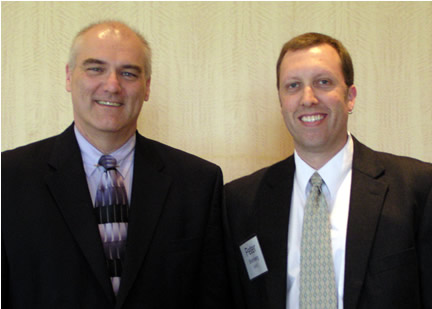
But I wasn’t the only one… Yesterday was MPOW‘s annual Spring Membership meeting (20th anniversary to boot), and we were delighted and honored to have OCLC VP for Member Services George Needham on hand to discuss OCLC’s must-read “Perceptions” report. I know it’s been out for awhile but if you haven’t read it yet, go read it. Or re-read it. Or read the 8 page conclusion. Or the respondent’s advice to libraries.
George’s talk was wonderful. Warm, reassuring and hopeful, while still being provocative and challenging. Here are some highlights:
- “It is not the customer’s job to understand us, it is our job to understand the customer.” (paraphrased from a comment made to OCLC Prez Jay Jordan, “It is not our job to understand OCLC, it is OCLC’s job to understand us.”
- “Convenience will always trump quality (so it is our job to make quality convenient.)”
- George summarized the points of Jennifer Rice, Omar Wasow, Antony Brewerton and Patricia Martin who spoke at OCLC’s mid-winter “Extreme Makever” symposium in San Antonio. The webcast and mp3s are available at: www.oclc.org/community. Of particular relevance to our audience was George quoting Jennifer Rice (Mantra Brand Consulting–great blog!) on the importance of libraries letting customers get a library card online. You can hear just that snippet of Jennifer’s talk here:(direct link or press the blue arrow.) This was particularly significant because we’re piloting a Get a Library Card Online project – aka GALCO– in New Jersey!
- What do customers tell us they want? More books, more copies, no fines, longer hours, more computers, friendlier staff, cleaner, better-lit, uncluttered facilities.
- George quoted Joan Frye Williams’ point that self-service isn’t synonymous with “no service” and would better be thought of as “self-directed” service. YES!!
Thanks Mr. Needham. Indeed, it was all good.
Scan this post

Kevin Kelly’s NY Times Magazine article, Scan This Book, blew my mind. I read it straight through on Sunday and have re-read selected snippets a few times trying to wrap my mind around the implications. Here are a few selections that really jumped out at me (with my comments if I rally the brain cells to assist me.)
Kelly writes,
The link and the tag may be two of the most important inventions of the last 50 years. They get their initial wave of power when we first code them into bits of text, but their real transformative energies fire up as ordinary users click on them in the course of everyday Web surfing, unaware that each humdrum click “votes” on a link, elevating its rank of relevance. You may think you are just browsing, casually inspecting this paragraph or that page, but in fact you are anonymously marking up the Web with bread crumbs of attention. These bits of interest are gathered and analyzed by search engines in order to strengthen the relationship between the end points of every link and the connections suggested by each tag. This is a type of intelligence common on the Web, but previously foreign to the world of books.
Mind blow the first: Simply by clicking on a link we are affecting the order the of the web. What seems to be a “read” action, turns out to be more of a “read/write” action. The more we click on something, the more likely it becomes that someone else will find it and click on it.
Kelly writes,
Once digitized, books can be unraveled into single pages or be reduced further, into snippets of a page. These snippets will be remixed into reordered books and virtual bookshelves. Just as the music audience now juggles and reorders songs into new albums (or “playlists,” as they are called in iTunes), the universal library will encourage the creation of virtual “bookshelves” — a collection of texts, some as short as a paragraph, others as long as entire books, that form a library shelf’s worth of specialized information. And as with music playlists, once created, these “bookshelves” will be published and swapped in the public commons. Once snippets, articles and pages of books become ubiquitous, shuffle-able and transferable, users will earn prestige and perhaps income for curating an excellent collection.
Mind blow the second: Individual enthusiasts writing, selecting, “curating”, mashing, may soon be on an equal footing with the “experts.” I can already see this happening with wikis and blogs. The truth is, I now get almost zero useful information from our professional literature (It takes me about 10 minutes to read American Libraries and/or LJ.) But I get an immense amount of useful and stimulating information –information that is helping me do my job better– from a number of library and marketing blogs that I read regularly with the the help of RSS. (So how long before we hear, “Dude, have you heard my mashup of Federalist #51 and the new Neil Young album? Publius rocks!!)
And there’s more. A lot more.
- The sorry state of our copyright law, and the black hole of out-of-print information it has created (sucking, sucking, sucking information away from the public domain.)
- The fact that a large % of out-of-print info can’t be put back into print because, well, because no one even knows who owns the copyrights.
- The possibility that Google can bring much of this “lost” information back into play by scanning and indexing it, thereby shifting the onus to copyright holders to exert claims (if they have them.)
- The filtering power of hyperlinks and tags to bring items that exist out on the long tail to peoples’ attention. (think: If you like Ryan Adams, you may like the Jayhawks, and if you like the Jayhawks you may like, Uncle Tupelo, and if like Uncle Tupelo, you may like Calexico, and if you like Calexico you may like Giant Sand, and if you like Giant Sand, you may like their album Glum (and that’s about as long tail as it gets.)
I’ll be re-reading this piece, and reading other blogger’s thoughts on it, trying to flesh out and extrapolate what it all means for libraries. It occurs to me that the Overdrive audiobooks platform already allows us to add our own pdf and audio content to the collection. Will librarians soon be performing more local collection development of digital formats?
The possibilities (and challenges) of adding exponentially more community created content (like Atlantic City’s teen poetry slam, or flickr photo sets, or autobiographies) as permanent additions to the collection is intriguing!
Carnival of the Infosciences is in Da Garden!

The carnival tent has been hoisted and is firmly staked in our lovely Library Garden awaiting for an amazing week. We have set up a ferris wheel for your those of you who feel the need to escape for just a little while and watch the world go by from up on high. Let us know what is going on in the biblioblogophere and join in the fun.
Please send your submissions to janieh [at] gmail dot com for edition #38 of the Carnival of the Infosciences .


 Library Garden