Posts filed under ‘Fun’
How to solidify your visual brand and identity
Hello, friends.
My name is John LeMasney, and I love libraries. I’m the newest blogger on Library Garden, and I’m thrilled and honored to be here.

- Image by nancydowd via Flickr
I’m a technologist, father, open source advocate, artist and designer, and I’ve been known to wax poetic about beer from time to time. I’ve been told by Ed Corrado, one of my favorite librarians, that I should start looking at an MLS. I told him I’d maybe think about it after I finish my Master of Arts in Organizational Leadership later this year.
I was invited to join Library Garden despite the fact that I have no MLS, I think, because I have a regular beat in the New Jersey library consortia, have many good friends who do have their MLS (many of them co-bloggers here) and I also tend to spend a lot of time in libraries.
As the newest blogger for Library Garden, I wanted to give a kind of gift to my fellow bloggers in the form of a new header for the blog. Peter Bromberg’s original header was simple, elegant, and straightforward, but he asked me if I wanted to take a shot at making a new one. I have given workshops on design for Peter, and others here, so I figured that it would be a good way to show some of what I know about design, as well as present a thank you gift to the group.
My process for design usually follows the procedure I’m about to record here, and it is how we came to our new header you see in our blog. You can click on any of the images in this post to see a full sized version of the image. I encourage it for the alternative headers, since it’s difficult to see the detail in the thumbnail.
Using the open source illustration application named Inkscape, I show the name of the organization in a list of fonts for the stakeholders that I think speak to the feel of their brand. I usually present a list of at least 5-10, but it’s not a set number. In this case, I shared the following image, which went a little further than simply listing fonts and had progressed to forming word-form relationships, which is typically a secondary process. Since I had access to the original header, I included it for comparison. No kerning or other fine tuning is done at this stage:

Possibilities
I got the feedback pretty quickly that people preferred the second and fourth design. They liked the boldness of Library in #2 and the finesse and softness of #4. People were positive, respectful, and kind and that always makes for a better design project. They said they liked the font used for garden in the 4th option, and might like to see it paired with other fonts.
I wanted to respect Peter’s previous work, celebrate the brand that is Library Garden, and above all respect the opinions and feelings of the stakeholders. I hope that I did that, and I am very happy with the work that we did to come up with this solution together.
In order to clarify what I was hearing, I sent out a revised picture of three options in which the less popular options were removed and a new option was generated making use of what was learned in the first round. That looked like this:

Possibilities refined
This set brought the garden font into focus as a definite, while showing that the great Gill Sans, one of my favorite fonts and shown in the first two options, as well as in the final result, had the versatility to provide the boldness that people were looking for in the third option.
Once we had our wordmark it was time to begin developing a background for the header on the blog. I decided to emphasize the garden aspect of Library Garden, relying on luscious foliage, summery greens, and deep layering.
I wanted to try to evoke the depth of information and directions and ideas available at your library. I wanted to show people the complexity and richness of their options when they walk in and sit down and talk with a reference librarian, for instance. I also wanted to try to celebrate the work, history, and richness of my fellow bloggers on this site.
So, if you feel that the work I’m about to show you is kind of busy, keep in mind that complexity, richness, layering, and depth were my goals. I didn’t want you to look at the header so much as dive into it.
With that said, let’s look at how the first header option came about. Note that at this point, I didn’t intend any longer to edit the text based information, and so I converted the text to paths in Inkscape. This makes it easier to nudge and relate letterforms and other elements. I tweaked the wordmark we collectively chose by fixing the kerning (space between letterforms) and exported it as a PNG in the exact size of Peter’s original header.

Wordmark Final
I opened up the GNU Image Manipulation Program (GIMP) and imported the wordmark, and then I added 3 transparent layers, named close, middle, and distant, so that I could add my visual elements in a layered way so as to build depth. I also duplicated the wordmark layer so that I could create a blur based glow effect to make the workmark pop up from the busy backgrounds. I saved it as a native GIMP XCF file to preserve the layer work and named it header template.xcf. Then I saved it as header option 1.xcf and began working on the first header possibility. I started with the template each time so I wouldn’t have to start from scratch each time. Templates are great, but I encourage you to roll your own, rather than relying on someone else’s.

Header Option 1
In retrospect, Option 1 is seen as the most tame, minimalist, straightforward, and quiet. None of these are bad things. It was early, easy play with greens and foliage brushes, and was intended really just to get my ideas out of my head and onto the screen. I worked back and forth between the layers, adding blocks of color in the deep layer, and thinner, more crisp elements in the foreground. Most of my objects and shapes are available to me as brushes I used from online brush sites such as those I bookmarked here. I thought of the process as though I was building a garden landscape scene, starting first with broad deep dark strokes, then building on top of that with thinner, more careful, contrasting details. My palette for this option was deep grass green, grayish midnight fields, moonlit patches, and a bright orange for contrast. People thought it was okay, but they liked the second option much more. So much more in fact, it almost got the nod.

Header Option 2
This one brought in much more of a Chinese influence — It was very much like option 1 in that it was mostly greens and greys, but it allows the eye to focus on the bright beautiful sunny flower peeking out, and is balanced nicely with the red signature stamp, both of which are parts of free brush sets, as well as most of the tree and foliage shapes you see. I would say that this option was a favorite for many. As I finished each option, I’d send out an email to the group asking for guidance and feedback, and they didn’t disappoint.

Header Option 3
Options 3 and 4 were simultaneously my favorites and the group’s least favorites. They consistently ended up at the end of the list of one’s preferences. They are both quite busy, very technology imagery driven, go deeper into what I think is an modernist color theorist’s palette that’s I’d call sporty, and are energetic to the point of dizziness.

Header Option 4
I love them both, but they were obviously (now) not the best choice for representing this group. I think I like their painterly style, deep layering, and rich color, but they’re not especially garden-y.
Perhaps the most important thing in design is knowing how to listen to your stakeholders, and being receptive to the survey even when it forks with your own feelings. I’m glad I made these options in order to provide contrast, offer other options, expand expectations, and most of all, in order to go a little too far. It’s hard to know when something’s right unless you’ve seen it go wrong, or at least wrong in the eyes of your stakeholders.
After hearing feedback at each new option, I learned that these people wanted clarity, simplicity, legibility, some energy, some calm, garden-ness, lush vegetation, and that no matter what, these were all okay — they’d all do the job. That’s reassuring when your client says no matter what, they’ll be happy. With that, I tried to pull all of this together in a final option, which ended up being the one that took the prize.

Header Option 5 with Chinese character
The only concern was that no one, including me, knew what the block and character in the lower left translated to. As a result, I decided to remove and replace them instead of potentially upsetting someone with the interpretation of the character. I replaced it with a postmark from a set of very cool stamp related brushes, and soon after, the header was in place.

Header Option 5 with Postmark.
I want to take this opportunity to say thank you to my fellow bloggers for their patience in the process, for the opportunity to collaborate and create together, and for the opportunity to have another great place such as Library Garden to share ideas. I feel very welcome here, and I’m looking forward to my our next post.
Submitted by: John LeMasney.
![Reblog this post [with Zemanta]](https://i0.wp.com/img.zemanta.com/reblog_c.png)
Unconference? – Pres4Lib – A Review

14 Words on a Slide

14words
In response to presentation at Computers in Libraries where a NEW RULE was handed down from on high: “NO MORE THAN 10 WORDS ON A SLIDE”
Um. No.
Orig photo from: http://www.flickr.com/photos/hurleygurley/4338767/
Clutter Lovers Unite: Don’t stress about the mess!
 I was gratified this morning to read this article in the New York Times by Sara Rimer: An orderly office? That’s personal. The article reports on Lisa Whited, an interior designer who specializes in adapting work spaces to the needs, habits, and goals of their users. She’s not your typical “get rid of the clutter now!” organizer. Instead of boilerplate suggestions for getting organized, Whited begins her jobs by interviewing clients to determine their specific work habits and styles.
What particularly caught my attention was that after interviewing her client (the author of the article), Whited surmised that she was the kind of person who needed to see things in front of her or else she forgot she had them, so putting things away in a filing cabinet might not be an effective organizational strategy. Reading those words, I wanted to reach into the paper (well, into the laptop–I read the Times online now) and wrap my arms around Whited and thank her for validating my life.
Out of Sight Out of Mind
See, I’m an out of sight out of mind kind of guy. Just today I came to work without my wallet (it was “put away” in a drawer), and twice last week I came to work without my phone (it was charging in another room.) I pretty much have to organize my morning so that anything that requires my attention (phone, wallet, pants. Well, maybe not pants, I’ve effectively habitualized that one) needs to be visible to me when I’m leaving the house.
 Likewise, with work. My whole organizational strategy is about keeping important things in my field of vision. If I’m not looking at it, it may as well not exist. (Note to friends and family: Apologies for being out of touch but I forgot that you existed.)
Since there’s only so much that I can keep on my desk, it’s generally not possible or practical to have too many physical reminders (notes, papers, etc.) in my field of vision. That’s why I rely heavily – VERY heavily – on text message and email reminders which I liberally set for myself using Google Calendar. (Note to Google Calendar: I’m not saying I’d leave my wife for you, but I admit we have something very special.)
Everyone I’ve ever worked with has learned that I will not see a message unless it’s placed on my chair seat. I’ve learned that if I need to do something first thing in the morning, I leave a note on my keyboard where I can’t miss it. Before text message reminders came into my life I relied heavily on taping notes to the doorknob at home (“remember to go to meeting in Trenton this morning!”)
While paper reminders in my field of vision can help, they also have their downside. One piece of paper can be accidentally placed over another piece of paper. Or it can blow away. Or it can have coffee spilled on it. For these reasons, I’ve actually arranged my work life to be as free from paper as possible. There’s probably the equivalent of 20 reams of paper sitting on my desk right now, most of it in colored folders. 98% of it has been generated by someone else and given to me at a meeting or conference. If it’s something I think I may ever want to reference again, I’ve trained myself to scan it into PDF so I have an electronic copy. One great benefit of putting everything into electronic format is that, thanks to Google Desktop Search, I can find anything I ever “touched” on my computer — email, website, pdf, etc. — immediately, and sometimes quicker!
Don’t Judge My Piles!
 While these piles on my desk may look like a mess to the outside observer, I like having them visible because they remind me to look through them now and then and pull out little tidbits. A note jotted in the margin a of a Powerpoint handout from a conference presentation or a handout from a workshop I’ve given (and completely forgotten about) can trigger new insights and connections, or give me a new perspective on a problem I’m dealing with. I like the serendipity of it. It’s both relaxing to me and stimulating.
Perhaps one reason most “get organized” books fail to help people like me is that they’re written by people who are not at all like me—they’re written by people who equate neatness with organization, and assume that a neat orderly environment is an a priori good and an end unto itself. I think the authors of these books are people who feel stressed out when they see a lot of stuff, so by gum they’re not only gonna put away their stuff, they’re gonna make sure MY stuff is put away too!
But they fail to appreciate that many people (like me) are NOT like them—we don’t function best when everything is “put away”, nor are we particularly stressed by clutter. In fact, I’m generally oblivious to clutter. I don’t even see the piles of paper on my desk.
Organization Is Not an End Unto Itself
This is what I want to tell the neatniks, declutterers, straighteners, and put-awayers of the world: Organization is a tool. It is a means to an end but it is NOT an end unto itself. The end is effectiveness. Happiness. Comfort. Flow. And I need lots of stuff around to achieve those states. So thanks for trying to help, but my brain isn’t wired like yours. So if I need help getting organized I’ll call Lisa Whited because she understands. It’s personal.
Links added April 2:
Friday Fun: Nap your way to success
[Note: this was a Toastmasters speech I gave last year, slightly revised for your reading pleasure.]
It has long been suspected, but scientific studies prove it: Napping is a great way to make it to the top.
If you don’t believe me, consider this: A study released by the National Sleep Foundation says that taking afternoon naps increases your productivity.
A Survey of American workers supports this finding with 40% reporting that daytime drowsiness prevents them from doing their best work.
But Napping doesn’t just improve our productivity, it may even save our lives.
 Consider this: Fatigue has widely been cited as a contributing factor to both the Three Mile Island and Chernobyl accidents. The Pepsi syndrome? I think not. The ambien syndrome, maybe… You know a few well-placed nap rooms at our nuclear facilities could make the difference between active workers and radioactive workers.
Sleep deprivation has also been cited as a contributing factor to numerous railroad accidents. Engineers need to spend less time on their feet and more time on their… caboose.
There are many studies that show a marked loss of alertness in the afternoon. Did you know that more accidents occur between 2 p.m. and 4 p.m. than in any other 2 hour span? And when you consider how many drunk people are bumping into things at 2 am on Saturday night, that’s a truly sobering thought.
So on one the hand we have the possibility of sleepy employees and train derailments and nuclear destruction, and on the other hand we have alert employees and an attentive, productive workforce. And yet Nap enthusiasts still find employer resistance to catching a little cubicle snooze. Why?
Why why, why?
Because the poor, sweet, gentle, nap has been unfairly stigmatized as the luxury of the rich or the indulgence of the lazy. This was probably epitomized in the classic Seinfeld episode when George Costanza worked so hard to conceal his dirty little napping secret: A nap chamber custom built into his desk. But as dumb and lazy as George Costanza was, he knew enough to avoid the stigma of the nap!
Unfortunately, the taint of napping in the workplace is all too real, so nap rooms may not soon be coming to an office near you.
But fear not fellow dozers, nodders, sleepers, and snoozers, all is not lost! Recent research in the field of creativity suggests that a mere BREAK in the “attentive activity” can lead to clearer, more creative thinking.
Scientists who have spent millions of dollars and years of their lives studying the phenomenon call this an “incubation hypothesis.” You and I call it “taking a break.”
According to the “incubation” hypothesis, it is best if we incubate once or twice a day for a period of 10-20 minutes and we should engage in no activity during this incubation. The incubations’ only function is to divert our attention from work, thus releasing our minds. We are thereby enabled to freshly engage in our tasks and do better creative problem solving when we return from the “incubation”.
I think Archimedes would wholeheartedly agree with the incubation hypothesis. In Greek probably, but he’d agree.
You remember the story of Archimedes? Eureka! Archimedes made a major scientific discovery while soaking in the tub. It’s suggested that Isaac Newton discovered gravity while lounging under an apple tree. And Frederick Banting, who dreamed how insulin could be used to control diabetes – and won the Nobel prize for his discovery-would certainly agree that a little shut-eye can work wonders.
So why do most employers still frown on napping and slacking? Maybe nappers need to get the research into the hands of a good PR firm. I can see the billboards now: Save a life, take a nap.
There is at least one major American company seems to get it. Google!
Google permits their employees to spend 20% of their time on non-work related activities. Stacy Sullivan, Google’s HR Director says,
“We want to take as much hurry and worry out of people’s lives as we can, because a relaxed state of mind unleashes creativity. Everybody’s on flextime here, so we don’t reward face time or working super-long hours. We just measure results.” And as we all know, the results at Google have been pretty good. Hey, maybe George Costanza had it right after all… Maybe sleeping our way to the top really is the way to go.
I will leave you to ponder: To drowse or not to drowse, That is the question.
Now if you’ll excuse me, I have a great deal of work to do so I’d better get back to my desk and, uh, nod off?
Friday Fun … the best band name for librarians
If you were in a band with a bunch of other librarians, what would you call it? Would you refer to your profession in the title?
Personally, if I were to be in a rock band with fellow librarians, I would go with:
The Dewey Decibel System
If it were an alternative band, I think it would favor:
Mending Potter’s Spine
So, let’s have a little fun this Friday; what are some great band names you can come up for the profession?
My First Year in Lines (Pete)
Taking a cue from Kathryn Greenhill’s meme, here are the first lines from the first posts for each month this year. (The fun thing about this, is I forgot ever having written most of it. So if I ever repeat myself, that’s why!)
January: Thanks to Amy for tagging me in the “Five Things” meme.
February: Check out this amazing video,”Web 2.0… the Machine is Us/ing Us,” created by Michael Wesch, Assistant Cultural Anthropology Professor at Kansas State University.
March: Zuula (http://www.zuula.com) is a newish metasearch engine that I’ve been enjoying.
April: Maria Palma over at “Customers are Always” recently posed the question, “What would make you stay loyal to a supermarket?”
May: I had the mind-blowing pleasure of attending Imagination to Transformation, the Mid-Atlantic Library Futures Conference, on Monday and Tuesday.
June: File under, “Tootling one’s own horn” In this case mine.
July: A few months ago I started taking Improv classes in Philadelphia on Monday nights.
August: As requested, here’s the link to the Wiki that supports the Magical Mystery Tour: http://librarygarden.pbwiki.com
September: If you get any invites from Quechup, delete them immediately.
October: David Lee King has offered up a new song/video Social Digital Revolution.
November: In my last post on The Human Touch I discussed how a warm, caring human being trumped a crappy, highly inconvenient system.
December: I started a little meme on Twitter on Thursday, which David Free picked up on and posted about over on his blog, David’s Random Stuff.
Friday Fun: #1 Song the Day You were Born
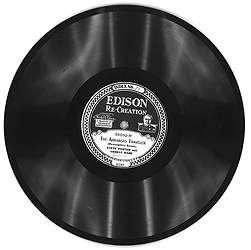
A friend just sent me this fun site: The #1 Song on this Date in History.
It is easy to use and you can have lots of fun looking up what was #1 on the day you were born, the day you got married, or any other occasion.
For me, the #1 song on the day I was born was “You’ve Lost That Lovin’ Feelin'” by The Righteous Brothers. I have also looked up the #1 songs for everyone in my family. It is fun! Give it a try!
I think I am going to incorporate this site in to my Introduction to the Internet class (I just happen to be updating it this month). The song lists go back to 1890 so even older adults will be able to find their #1 song and it will be a fun exercise for practicing mouse skills, following links and scrolling.
So, now we can all share — What was the #1 song on the day you were born? (then we can all have fun guessing what year it was!)
Marie’s 8 Things
In the interest of being a member of the LG team, here goes my 8 revelations. Warning to all, the below is (almost) totally unrelated to librarianship. Abandon hope all ye who enter here!
1. If you have ever heard me speak, you may be surprised to learn that I had a bad lisp as a kid. My speech therapist advised me to take up public speaking to help overcome the lisp. Now I have a passion for public speaking and have had a career in teaching/librarianship (from Kindergarten through Doctoral courses and every grade level in between) and can’t get enough of either.
2. Following from the above, I admit that the famous YA advocate Mary K. Chelton, of Queens College, has (affectionately I hope!) dubbed me a “great big ham.” It fits.
3. After the lisp removal, I wore braces for 4 years in HS. Yuck! Today kids wear trendy colored braces in JH which are a status symbol of sorts. Not so then, when I endured being called “tin grin,” “can opener mouth,” (and worse unpleasantries that shall remain nameless). I must say, however, that this horrific experience made me a better person, especially later, when I was a school librarian with zero tolerance for vicious name calling or bullying.
4. Acting again on the advice of my speech therapist, I got involved in radio and had my own late night show for 4 years on the College of NJ (then Trenton State College) radio station, WTSR. My air name was “Me” and I played blues and rock n’ roll.
5. At WTSR (still WTSR 91.3 FM to this very day) I recollect that I once had a mad crush on another DJ whose show followed mine. I later found out he was gay (sigh). I should have known better, as his air name was “Peter Pan.” You can’t make this stuff up.
6. I am totally untalented when it comes to athletics, but I’ve been: an assistant cheerleading coach (to purge my intense dislike of cheerleaders, acquired in HS, see #3 above), a girl’s softball umpire, a scouting assistant to a HS football coach, and a choreographer for a HS production of Oklahoma.
7. I have never had the urge to do the following: ski, sky-dive, skateboard, bungee jump, or surf. But I have parasailed in Acapulco, ridden a motorcycle, refinished loads of antiques, and driven from NJ to Houston to cheer the Rutgers football team to its 1st bowl victory ever in the Texas Bowl last December.
8. I have had drinks with Umberto Eco at Erica Jong’s apartment. Read more about this story from my husband Gary’s point of view at his website (note the photo credit for the picture of Gary with Umberto!)
Amy’s 8 Things
(Hmmm I kinda like the sound of that)!
So I have been tagged here and on the PML blog – do I have to come up with 16 things or should I just refer you there!? 😉 EDIT: Okay I managed to come up with 8 more – if you’re really bored or interested check them out! 😉
Well, I’ll do 8 here and then see what happens:
1. I like to keep my fingernails really short because I can’t stand typing on the keyboard with long ones. I spend so much time typing that it really is an issue for me and I can now hardly stand for them to be much longer than the very end of the tips of my fingers. This is okay though because I also pretty much prefer them this way and like the way they look. I also like to paint them dark red.
2. When I was little we had a tire swing in the backyard, hanging from a very large, old tree. I used to play outside on that tire swing all by myself for hours! One thing I would do was to “broadcast” my own radio show while I swung around (weird).
3. I have worked in the following places: a 5 & 10 store; CVS; a Mail Boxes, Etc. (no, it wasn’t a UPS Store back then); a Manhattan publishing company; the Clifton (NJ) Public Library; and now at the Paterson (NJ) Free Public Library. It NEVER occurred to me to become a librarian, not even once, for one second, even though I went there ALL THE TIME, until about the year 2001.
4. I used to have a really weird habit of washing my feet before I went to bed. I just hated the idea of putting dirty feet into my bed. I don’t know why I used to do that, and I don’t really know exactly when or why I stopped doing that.
5. I don’t really like to cook. My husband doesn’t really like this fact about me.
6. I have never, ever, ever smoked a cigarette. Not even one puff once to try it. Never.
7. The first car I ever owned, which I bought myself, was a used Nissan Sentra. Stick shift. I didn’t know how to drive stick. I couldn’t even drive the car home myself. While learning to drive it, I once drove it right through the garage door! The only person who finally succeeded in teaching me how to drive that thing was a friend of my mom’s. She was also my brother’s Pre-K teacher and also then became a librarian!
8. I used to be a soccer superstar!
And, I’m not tagging anyone else. I hope that won’t bring me 8 million years of bad luck or something…!!??!?


 Library Garden