Author Archive
Blog-based library websites: An interview with David Lisa
 I recently sat down with (ok, meebo‘d) David Lisa, Director of the West Long Branch (NJ) Public Library, to discuss how he recently converted his traditional library webpage to a blog-based webpage.
Pete: Thanks for joining me this afternoon.
Dave: Always a pleasure!
Pete: For starters, tell me a little about yourself and your library.
Dave: My name is David Lisa and I am the Director of the West Long Branch Public Library. We are a small municipal public library. West Long Branch has about 8700 residents. We have three full-time employees and 7 part-time, 3 pages (PT) and one volunteer. I’m the only professional on staff. Other than that, we are your normal small burg PL.
Pete: Thanks Dave. So tell us a bit about your decision to make your webpage blog-based.
Dave: I had worked on several different templates for the new version of our website and nothing was working. Then I attended the Web 2.0 seminar led by Michael Stephens and Jenny Levine and took what the speakers said to heart. It really seemed to me that if we started with a Blogger.com format and expanded upon that, we would be able to accomplish what we wanted to do. Namely to be able to give our users news about programming, spotlight our collection and keep them up to date on new additions to our collection. It also dawned upon me that we could utilize Blogger’s template structure to organize our website by listing the links to the various pages on our site in the right column and be able to provide an archive etc. It did everything we needed! So, I set to work setting it up, then “adapted” our extant pages to the Blogger template format.

Pete: Yes, the built-in archive feature is wonderful. Are there any other specific benefits that you see with a blog-based website? Any drawbacks?
Dave: Well we are getting lots of great comments about how up to date our site is. People really like seeing the latest news on the front page in reverse chronological order. And, of course, one big benefit is being able to offer an RSS feed through Feedburner. We like to stress that we can bring the news about the library to you on your schedule rather than you having to come to us all the time. One drawback has been that we have found that not a lot of people are acquainted with RSS feeds and we have to explain how to subscribe a lot.
Pete: That leads into my next question (or series of questions): Do you find that your customers understand the RSS feed? Are they using it? Have you done anything to promote the feed and/or teach your customers how to use it?
Dave: As I mentioned, there is some confusion about RSS still. I see that as being general initial confusion amongst the public at large. We really wanted to get the feed through Feedburner since they do a good job explaining it. We are pleased to have the feed in place and are actually waiting to see how it works out…right now.
Pete: Well, I think you’re ahead of the curve. I believe the next release of IE will have built in RSS detection and reader. At that point, knowledge and use of RSS among the general population is likely to grow quickly and exponentially.
Dave: That’s a good example of the confusion…try setting up an RSS feed with Firefox and IE and it’s a different experience. We wanted the user to be able to click through the experience and know little about what they had to do to make it work. Feedburner does a great job enabling that.
Pete: And of course Feedburner gives you great stats and bunch of other nice benefits!
Dave: Feedburner has a nice page that you get after you click on our Subscribe link and it explains the variety of choices of RSS readers.
Pete: How much technical ability is needed to create a blog-based website? Is it something anyone can do or is a certain level of technical know-how necessary?
Dave: Good question. I believe that the approach we took to revamping our website takes little web publishing knowledge and could be mounted by people with little experience. And I think that is the direction web publishing is taking. Jenny [Levine] and Michael [Stephens] mentioned that web publishing software (Dreamweaver, FrontPage, etc.) will be outmoded by this approach soon… and I believe them.
Pete: Well, Blogger, Typepad, WordPress really make it easy!
Pete: I see you have multiple authors. Who gets to post, and what do they get to post about? Did you and your staff come up with a blogging policy?
Dave: Glad you asked that question. From the get -go, I wanted our library website/blog to be a collaborative effort. I met with my Administrative staff and indicated that since we were re-creating the website in this fashion, I wanted them all to be involved. I also involved key members of the part time staff too (Book Discussion group moderator, etc).
Pete: That’s great!
Dave: I also wanted staff members that are posting to be recognizable by name to library patrons that read the blog and could answer questions. We crave a fandom. [smile]. This is a truly collaborative experience.
Pete: I salute you! The research going on in virtual reference shows that customers really like to have a name associated with the librarian (as opposed to being served by ‘librarian34’). Using names is a great way to bring about more of a sense of personal connection.
Dave: I wouldn’t have it any other way…I want it to be a personal experience for the user. We want to hear this: “Wow, Janice recommended the new DVD Lucky # Slevin. I checked it out and I loved it. Thanks Janice!”
Pete: OK, since we’re on the topic of collaboration… It doesn’t look like you have comments enabled. Any plan to enable comments?
Dave: We purposefully disabled it for now. We do have plans to enable them at some point, but we want to plan for it so we can handle it correctly.
Pete: Well Dave, I think you’ve done a great job with the site, and I appreciate you taking the time to share your experience with us. Is there anything you’d like to add before we conclude?
Dave: I’d just like to say that we actually stumbled upon this idea by accident, and it was all due to the seminar… so thanks for sponsoring it. We’re always looking for new and different ways to do things here at WLBPL and we are having lots of fun with the website/blog.
Pete: Credit for sponsoring the seminar goes to Princeton Public Library and CJRLC (although we also had Michael Stephens present for SJRLC members that same week.)
Dave: Thanks for interviewing me!
Pete: You’re welcome Dave. Thanks again for your time.
Wikipedia v. Britannica: This time it’s personal
 Get thee over to the Wall Street Journal and read this gloves-off (you know, in a genteel way) debate between Jimmy Wales, founder of Wikipedia, and Dale Hoiberg, editor-in-chief of Britannica. Here’s a taste:
Mr. Hoiberg: No, we don’t publish rough drafts. We want our articles to be correct before they are published. We stand behind our process, based on trained editors and fact-checkers, more than 4,000 experts, and sound writing. Our model works well. Wikipedia is very different, but nothing in their model suggests we should change what we do.
Mr. Wales: Fitting words for an epitaph… …We are open and transparent and eager to help people find criticisms of us. Disconcerting and unusual, I know. But, well, welcome to the Internet.
Personally, it took me a while to get to the point where I feel a fair level of trust in the quality of Wikipedia. I think Wales has done an excellent job of creating a system that maximizes the benefits of open source collaboration, while minimizing the drawback and dangers of having too much openness. I’m reminded of the brilliant article Clay Shirkey wrote a few years ago, “A Group is it’s own worst enemy“. Shirkey, building off of the concepts expressed by psychologist W.R. Bion in his seminal work,”Experiences in Groups“, wrote,
Group structure is necessary to defend the group from itself. Group structure exists to keep a group on target, on track, on message, on charter, whatever. To keep a group focused on its own sophisticated goals and to keep a group from sliding into these basic [destructive] patterns. Group structure defends the group from the action of its own members. (emphasis is mine, pjb)
I remember being struck by Bion’s work when I first read him in a college psych class, but Shirkey really brings it home. Although Shirkey is mostly focusing on social software, the concepts expressed in “Own Worst Enemy” are applicable well beyond that topic, and you might find yourself reflecting on the structure and health of your library (or your Bridge club, or your — um, make that OUR — government). Geek confession: I keep a copy of Shirkey’s article in a “Ponderables” binder on my night table and re-read it regularly.
But I digress. Point is, Wales has done a great job of keeping Wikipedia from being it’s own worst enemy, and I’ve seriously warmed up to Wikipedia as a trusted source.
Blog Day (late and a dollar short)
 Happy (belated) Blog Day everyone. I’ve been on vacation much of the past three weeks, watching the US Open and getting in as much tennis as I can, and in my rare state of email disconnection I missed blog day… So a day late, here are five blogs that I dig.
- Michelle Boule’s, A Wandering Eyre. I first became aware of Michelle’s blog when we participated in ALA’s Web 2.0 Bootcamp. She’s been knocking me out ever since. My biggest disappointment at ALA was that I wasn’t able to push myself across the crowded room at the Blogger Bash fast enough to say hello. Hi Michelle!
- Meredith Farkas’ Information Wants to Be Free. A great voice, great honesty, lots of smarts, humor, perspective. Meredith helps me broaden my knowledge, think more deeply, and just plain refreshes my hope for our profession.
- Blog About Libraries is a group blog much like the garden. I particularly enjoy Steve Backs’ posts on customer service. I share and am inspired by his customer-centered outlook and approach to library services.
- Signum sine tinnitu–by Guy Kawasaki: I love the marketing ideas, the interviews with brilliant and interesting people and Guy’s laid back vibe. It never fails to entertain or inform, often at the same time.
- Creating Passionate Users . Written mostly by Kathy Sierra, along with a few other authors of O’Reilly’s “Head First” series, CPU is my “desert island blog”. If I was stranded on a deserted island with my laptop and a wireless connection, this is the one I’d read. It activates the part of my brain that dopes me with endorphins when giving (or receiving good customer service) while also appealing to the trainer-boy in me. I love Kathy’s insights on how to present information in a way that helps people get it, or “kick ass.” To the extent that I kick ass on any given day, Creating Passionate Users helps keep my aim accurate 🙂
Certainly not an exhaustive list, and it’s hard not to mention all of the blogs that I love and read regularly. But I’d feel super-remiss if I didn’t give a shout out to Karen Schneider’s Free Range Librarian and Michael Stephens’ Tame the Web. I have never in my life manifested an addictive behavior—until I started reading these blogs.
Is virtual reference successful? Part III (Hint: yes it is)
 In parts one and two I raised a series of objections to Pascal Lupien’s article in Online, “Virtual Reference in the Age of Pop-Up Blockers, Firewalls, and Service Pack 2“
In part three I’d like to address the end of the article where Lupien makes a case for using IM instead of standard VR software to do virtual reference. In fact, I agree with all of Lupien’s main points:
- IM is generally free.
- It is easy to use, from the patron’s perspective as well as on the library side
- Unlike VR software, IM works with most computers, operating systems, and connection speeds.
- It does not require the patron to download software or configure a browser.
- [IM is] faster, as patrons who already use an IM system can simply add the library service to their list of “buddies” and message a librarian when they require assistance.
Not only do I find IM to be a perfectly good tool for reference work, I think it is quickly becoming (has become?) a standard mode of communication that every library should consider offering as a point of contact for their customers. Libraries, get an AIM Screenname, get a yahoo ID, sign up for Meebo, (maybe add the MeeboMe widget to your webpage) and start chatting with your customers!
But why limit IM to reference? We don’t limit the phone to reference, do we? IM is just another way for our customers to contact us. Larger libraries can give each department their own IM identities, (i.e. “extensions”) and let the customer choose which department to connect with. If a session needs to be ‘tranfered’ to another department, library staff can invite the customer and someone from the correct department into a new chat room, and viola! the session has been tranfered. So many of our customers are on their computers all day (and night) it just makes good sense to give them a quick, convenient option for contacting us.
But back to the article. Although I agree with everything Lupien wrote about the benefits of using IM to do virtual reference, he doesn’t address the key reasons many VR services don’t use it. These reasons were brought up in a great discussion about “The Future of IM” that took place on the digref listserv last month. (follow the link, then scroll down to the ‘future of IM’ thread to read the whole megillah.)
Caleb Tucker-Raymond, who expertly manages Oregon’s VR service, started the thread and summed up some of the key points in this post, excerpted below:
- Sarah Houghton mentioned multiple librarians need to be able to monitor a single screen name.
- Jean Ferguson said that she that her campus enterprise IM software (Jabber) doesn’t talk to commercial IM networks (like AOL).
- Jean also mentioned the need for a solution for the patron without an account (such as, come in anonymously over the web)
All true, all true. But Sharon Morris, until recently the VR Coordinator for AskColorado (congrats on the new job Sharon!) hit the collaborative VR software nail squarely on its pointed little head when she wrote:
24/7 availability is essential to making libraries accessible anywhere, anytime on the Internet. IM at this point does not offer the extra staffing/cooperation model that makes VR such an amazing step forward for library services on the Internet. (emphasis is mine.)
VR software gives us the power to collaborate. That gives us the power to offer 24/7 service and THAT makes customers (and the press) sit up and take notice. It also gives regional and statewide VR collaboratives the ability to market a single, powerful, expectation-busting, W-O-W, library service. We don’t get opportunities like that every day. Bottom line: Beyond the fact that VR software gives us the power to offer convenient, relevant, 24/7 service, it gives us the power to change peoples’ perceptions about libraries. I would argue that we have done just that. In my book that far outweighs any of the downsides that Lupien raised about the bugginess and technical limitations of VR software. Perhaps I should say, far outweighs for now…
One final, more personal point before wrapping this up. I’m unhappy with the snarky tone I took in responding to Lupien’s article in part one, and I realize it was not productive to take such a tone. It came partly from writing much to late, while far too tired, and partly from my own deep wish for librarians to stay focused on the bigger picture of customer experience, and my perception that the article lacked that focus (whether it did or didn’t, dear reader, you may decide.) I am not trying to make excuses for my snarkiness, just offering a little self-reflection from a nascent blogger, tinged with a bit of regret. I will try to do better.
I am convinced that Pascal Lupien cares deeply about the vitality and relevance of libraries and the importance of customer experience. I recently found a copy of his presentation, (along with Lorna Rourke) Adding a Personal Touch to a Virtual World, presented at Computers in Libraries, 2006. This presentation gave me a fuller picture of Pascal Lupien’s attitudes, concerns, and values and I found myself nodding in almost constant appreciation and agreement with his work.
OK, that’s all I’ll be posting about VR for now. Back to customer service!
Technorati Tag: vr | Technorati Tag: virtual reference | Technorati Tag: im | Technorati Tag: instant messaging
Check out: Ten Questions with Seth Godin
 Guy Kawasaki, who blogs over at Signum sine tinnitu, has posted Ten Questions with Seth Godin. (one of my favorite non-librarian blogger/writers.)
Seth on books:
Books are the new t-shirts. We used to buy t-shirts as a way of covering our hard abs. Now, though, the purpose of the t-shirt is to be a souvenir, to give us a concrete way to remember something that mattered to us—and to give us an easy way to spread that idea to others.
Seth on how blogs help build brands:
…human beings respond to stories, and stories, the best ones, are personal.
Seth on five things that enabled him to be successful:
- No ulterior motive. I rarely do A as a calculated tactic to get B. I do A because I believe in A, or it excites me or it’s the right thing to do. That’s it. No secret agendas.
- I don’t think my audience owes me anything. It’s always their turn.
- I’m in a hurry to make mistakes and get feedback and get that next idea out there. I’m not in a hurry, at all, to finish the “bigger” project, to get to the finish line.
- I do things where I actually think I’m right, as opposed to where I think succeeding will make me successful. When you think you’re right, it’s more fun and your passion shows through.
- I’ve tried to pare down my day so that the stuff I actually do is pretty well leveraged. That, and I show up. Showing up is underrated. (emphasis is
mine -pb)
If you like what you read, check out the rest of the post here, then amble on over to Seth’s blog.
Free AOL – How to convert your paid account
 Heads up–we may be getting questions on this at the reference desk.
AOL is now giving away their service for free. If you’re already an AOL subscriber, but don’t rely on AOL to connect to the Internet, you can switch to the free plan. (If you rely on AOL for actual Internet access, then you’ll still have to cough up some dough.)
Currently AOL is telling customers, “To change your current AOL plan, simply call Member Services at 1-800-984-6207 and select the Billing Option when prompted.” I tried this, and after spending 20 minutes navigating their (gasp!) poorly designed voice-menu, I actually got through to a nice fellow who told me how to cancel. THIS IS BIG SO READ ON…
Although AOL is not really advertising it yet, subscribers can easily make the switch to the free plan by:
- Logging into AOL (log in through their software–sorry, this won’t work through http://www.aol.com/; at least not yet…)
- Choosing KEYWORD: Change plan
- Choosing the option for “Free Plan”
I’ve done it, and I’m here to tell you that it was that easy. A pleasant surprise, especially considering AOL’s well-documented history of making it nigh impossible to discontinue service.
For the first time in many years I’m moved to say, Thank You AOL!
(cross-posted at my new work blog http://sjrlc.typepad.com )
Is virtual reference successful? Part II (Hint: yes it is)
In Part II I’d like to respond specifically to two comments. The first is from Morgan Fielman. The second from Pascal Lupien, author the article I’m discussing.
RESPONDING TO FIELMAN
Commenter Morgan Fielman wrote, “The original poster seems to have missed the point of this article, which is primarily about software.”
No, I get that the point of the article is primarily about the software and not the customer experience. But the article is so broadly written and lacking in detail that it ends up saying nothing more specific than “VR software has problems.”
My questions, unanswered by the article are, What software? What problems? Two of the products Lupien writes about (Tutor.com’s and QuestionPoints’) recently underwent complete overhauls, in effect becoming completely new products. It is unclear from Lupien’s article which versions he’s writing about but my sense is he’s writing about the older versions. If that’s correct then most of the article is, at best, moot.
Granted, the larger issue of whether or not the software is effective is a valid issue that warrants exploration and discussion. Fielman goes on to ask, “but how can customers be satisfied when the software we use is so poor?” I say that’s the wrong question. The question is “Are customers satisfied?” The answer in our customers’ experience is yes, they are satisfied. We didn’t find this out by polling 20 libraries. We found this out by asking the customers. Another good question might be, “Do the problems with VR software affect the quality of the customer experience, and if so how and to what extent.” There are many people at collaborative VR services looking at a lot of data to answer that question. Lupien’s article suggests that problems with software affect the customer experience but offers no actual data to back it up. He mentions problems with popup windows, problems with Windows service pack 2, and problems with serving customers who use Macs, but he is not specific about which software products exhibit which problems and to what extent. And again, Lupien is not clear which version of Tutor and QuestionPoint he’s talking about. The newer versions of both products are compatible with Mac users, and have no problems with service pack 2 issues that I’m aware of.
Fielman concludes his comment by saying “original VR supporters have realized that this service just isn’t cutting it.” The fact is our service has been cutting it for almost 5 years, and we have the hard data and glowing customer comments to prove it. If your VR service isn’t cutting it, you need to ask why. Are your staff trained on the software? Are they enthusiastic? What are you customer service standards? Do your librarians give kick-ass customer service in f2f encounters? What quality control mechanisms do you have in place? Do you examine your transcripts for quality? Do you have regular and convenient service hours? Are you available 24/7? (going 24/7 made a huge difference in our usage, even though usage mostly grew during hours we were already open — go figure…) And finally, but certainly not last, do you consistently and effectively market your service to your customers? Do they know you exist???
If your service ain’t cutting it maybe you need to answer these questions first before blaming the software, which is an easy way out. Consider that here in New Jersey using standard VR software (currently QP, formerly Tutor/LSSI’s eGain-based software) we’re cutting it and then some. Other statewide collaboratives are doing quite well too. And we’re all working very diligently with our respective vendors to ensure that our VR platforms are stable and highly functional. While the current glitch here and there can be a real and undeniable pain in the ass, it hasn’t prevented us from delivering a high quality and slightly mind-blowing experience to our customers.
RESPONDING TO LUPIEN
First, I’d like to thank Pascal Lupien for taking the time to offer an extremely well-written and thoughtful comment in response to my first post. I’d like to assure him that contrary to his assertion, I’ve read his article through thoroughly a few times. I have no problem with bad news about VR. I just want accurate and somewhat substantiated news. I’m offering up the reality of my experience at QandANJ to counter the broad statements that Lupien makes. Now to some of his specific comments.
He writes, Perhaps these results aren’t what proponents of VR would prefer to hear, but they do represent a problem that needs to be discussed, for the sake of our users.
I do not consider myself a proponent of VR, I consider myself of proponent of libraries. It is my desire that libraries remain relevant to our customers by offering a suite of high quality services. Collaborative VR is one such service, offering our customers 24/7 access where and when they want it. I want to see libraries changing their customers’ perceptions about what libraries can offer them. I want libraries to blow customer expectations out of the water. I want libraries to be around in 50 years. It is not that I don’t want to hear bad news about VR software. I’m perfectly open to hearing about the problems with the current stable of VR software offerings. It’s just that I want to hear facts, not conjecture. And I want those facts to be couched in some meaningful context and always tied back, to whatever extent possible, to the impact on our customers. I didn’t get this from Lupien’s article.
Lupien writes, To respond to the person who claimed that software is the last thing that matters about VR, I say tell that to the user who is unable to log in because she uses a Mac, or because her computer has pop-up blockers. Tell that to the user who is “kicked off” in the middle of a session because the VR software does not function properly with the library’s licensed databases. These things happen regularly, and this article makes an attempt to discuss them.
I’m pleased to see Lupien talking directly about the impact on customers. Clearly we agree that it would be optimal if VR software worked across all platforms, had no problems with pop-up blockers, and worked 100% of the time so no user was ever “kicked off.” I am not suggesting that these problems don’t exist, I am asking to what extent do they exist, and to what extent do they impact the customer’s experience and satisfaction with VR service. Because Lupien fails to identify what versions of the various VR products he tested, and is repeatedly non-specific regarding his data, the article fails to answer these questions.
Lupien grants that, “many regular VR users appreciate the service,” and that he wasn’t contesting that fact. Our experience suggests that it is not “many” but most.
Lupien writes, “Shouldn’t we be thinking about these potential users as well, rather than focusing on those who already use and appreciate the service? Shouldn’t we be trying to determine if one software product could help us to improve the experience for all users, not merely the satisfied ones? Perhaps some would fear doing this, as it would reveal that their VR service isn’t as successful and user-friendly as they like to claim?
Yes, we should absolutely be thinking about our potential users, and we should always be shooting for a platform that will provide high quality service to everyone. Again, it’s a matter of facts and context. Lupien’s article disappoints me on both counts.
Lupien writes, “The point of this article is to focus on users who are unable to log in to begin with, who encounter technical problems during a transaction, or who choose not to use the service because they would be required to disable pop-up blockers or use a particular browser, etc. We’ll never know how these users feel about VR, because they don’t get far enough into a VR transaction to make…comments.
Actually, we have some way of knowing. We ask. Yes sir, right there on the front page of QandANJ we say, “Click here to give us feedback on how our new software is working for you.” Here’s a sample of what we find: Since May 1st (79 days), we have received 23 comments. 16 of them were specifically technical (some were positive, some were of the nature, “it wasn’t fast enough”.) One comment came from a Mac user, 3 came from customers accessing us through the AOL interface and browser. So Mr. Lupien, we do make an effort to compile and monitor such information, looking for problematic trends with an eye on improving the service.
Finally, Lupien suggests that I have not been keeping up with the VR literature and if I had “taken the time to consider some of the issues discussed in this article before jumping on that user-centric high horse” I would have “come away with a better understanding of what is happening beyond QandANJ.”
I can assure Mr. Lupien that I keep up quite well with VR literature thank you, and I’m familiar with Coffman and Arret’s article, which you can read here (right at the bottom of the page, after Brenda Bailey-Hainer’s reasoned response.) And if speaking from a place of fact and experience instead of conjecture and generality puts me on a high horse then what can I say? Giddyup.
In Part III (much shorter, I promise) I’ll address the VR software versus IM question.
Epilogue: Customer comment from today: “I am exceedingly impressed. First time in ages I felt like I was getting something positive for my tax dollars.” (Our funders sure hate to see this… Ha Ha )
Is virtual reference successful? Part I (Hint: yes it is)
 Pascal Lupien begins his recent article on virtual reference (Virtual Reference in the Age of Pop-Up Blockers, Firewalls, and Service Pack 2 , By: Lupien, Pascal, Online, Jul/Aug2006, Vol. 30, Issue 4) “by declaring that, “the evidence indicates that libraries are not satisfied with the service.” Say what? Aside from the fact that the statement is so overly broad as to be false on the face of it (which libraries? which services?), it’s not about whether the libraries are satisfied with the service, IT’S ABOUT WHETHER THE CUSTOMERS ARE SATISFIED WITH THE SERVICE.
The fact that Lupien goes on for nearly 3500 words with nary a mention of customer satisfaction epitomizes to me the worst of librarian-centric thinking at the expense of customer experience. 3500 words with:
- No mention of how VR customers love and rave about the convenience of the service.
- No mention of how VR customers love and rave about having a live person available to assist them with their information needs.
- No mention of how VR has changed our customers’ perceptions of what libraries can offer them.
- No mention of how VR has helped make libraries more relevant to our customers by meeting their needs and exceeding their expectations.
I am feeling weary after reading Lupien’s article. Weary because there is so much wrong with it that it almost demands a line-by-line critique in the spirit of Twain on Fenimore Cooper. Well Lupien isn’t Fenimore Cooper and I’m certainly not Twain, and besides I’m really, really tired.
So let me address a few errors, raise a few eyebrows (two, to be precise) and share some of my own experience – uh, make that our customers’ experience – with VR via QandANJ.
A moment to share my creds: I’ve been involved with QandANJ since it’s inception in 2001 (before that, actually,) helping to build, manage and promote the service. I’ve looked at thousands of transcripts and thousands of customer feedback forms. I know that our usage is through the roof. We handle as many “calls” as we can limited only by our ability to offer deeper staffing. I know that our customers tend to be very satisfied, and I know WHY our customers tend to be very satisfied. If you want to delve deeper into our stats and findings, take a look at this presentation from the VRD Conference in 2003. (there’s more here) The numbers may be a little dated, but the story they tell and the trends they point to remain just as true today.
I’m not making this stuff up… Here’s one of my favorite comments:

If you think this is cherry picking, it ain’t. We get our share of negative comments too (usually younger users, usually wanting “faster, faster, faster” service.) The reality is our customers are happy. Why? Here’s what they tell us:
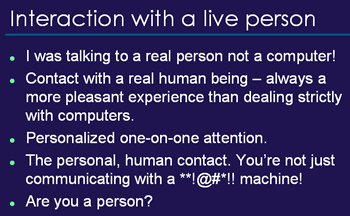

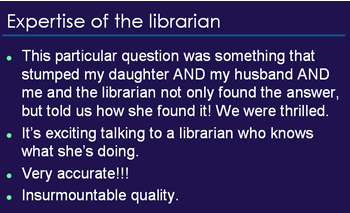
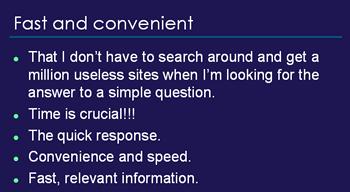
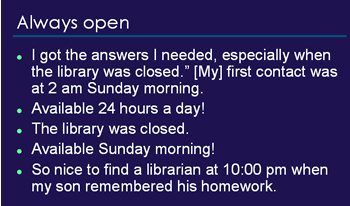
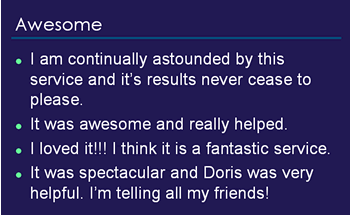

We have hundreds of pages of single-spaced pages with thousands of comments that go on and on in these veins. There are many other successful collaborative VR projects like those in Maryland, Colorado, and Cleveland that could show you similar comments from their satisfied customers. The challenge isn’t attracting the customers, it’s managing to grow the staffing of the service to keep pace with the demand!
In part 2, I’ll get a bit more nit-picky with other elements of Lupien’s article.
Dogmas Are Meant to be Broken: An Interview with Eric Reiss – Boxes and Arrows: The design behind the design
A little Friday lunchtime reading… If you like the Dogma, follow the link and read the interview with Reiss. I’m going to be re-evaluating mpow’s website with these 10 points in mind.
——————————————————————–
From: Dogmas Are Meant to be Broken: An Interview with Eric Reiss – Boxes and Arrows: The design behind the design:
“Web Dogma ‘06”
1. Anything that exists only to satisfy the internal politics of the site owner must be eliminated.
2. Anything that exists only to satisfy the ego of the designer must be eliminated.
3. Anything that is irrelevant within the context of the page must be eliminated.
4. Any feature or technique that reduces the visitor’s ability to navigate freely must be reworked or eliminated.
5. Any interactive object that forces the visitor to guess its meaning must be reworked or eliminated.
6. No software, apart from the browser itself, must be required to get the site to work correctly.
7. Content must be readable first, printable second, downloadable third.
8. Usability must never be sacrificed for the sake of a style guide.
9. No visitor must be forced to register or surrender personal data unless the site owner is unable to provide a service or complete a transaction without it.
10. Break any of these rules sooner than do anything outright barbarous. “
Pix from New Orleans

 Arrived in New Orleans last night. Had a delicious fried catfish and my wife had an equally yummy chicken marsala. Long wait (I think the restaurant was understaffed) but the food was worth it!
This morning we headed straight to Cafe Du Monde for coffee and beignets. I’m still buzzing…
On our way to the the OCLC Symposium, “ Preserving Library Core Value and Envisioning the Future “. I’m especially looking forward to hearing Stacey Aldrich, Assistant Director of the Omaha Public Library System. Her presentations on scenario building and future thinking are always thought-provoking. And OCLC has hit homeruns with their last few symposia (Long Tail, Extreme Makeover), so I’m pretty primed for this one!


 Library Garden