Archive for 2008
Interesting Election reference question . . .
Last night during the presidential debate I got a very interesting reference question: What happens if either of the presidential candidates dies between now and Election Day?
I looked into it and it is not exactly clear! But there is a lot of information and speculation out there regarding this issue and what would happen.
Basically, both the Democratic National Committee and the Republican National Committee have rules stating they are responsible for filling vacancies if something happens to their nominee. The Republican rules are a bit more explicit in how it would happen. But neither is absolutely clear. (See Republican rules and Democratic rules for yourselves.)
I found other clarification on wiki answers. Essentially, if a candidate dies before Election Day, the party’s committee (somehow) votes on a new candidate. Of course, the closer to Election Day it happened, the more difficult that would be because of ballot printing, etc. Congress could choose to push back Election Day to allow time for the parties to regroup and to get the word out about the new candidate selection. It does seem clear, however, that the VP candidate is not necessarily the shoe-in in such a scenario.
Another post I found, from October 2000, addresses these issues as well as some other “disaster scenarios” that could happen. To check it out, click here.
Embedding Facebook Video with Greasemonkey – Revised
QandANJ.org recently launched its second commercial which premiered during the MTV Video Music Awards (and is now showing during Project Runway).
In an effort to extend the reach of the commercial, we’ve posted it to YouTube and to our MySpace and Facebook pages, and we’ve encouraged anyone and everyone to embed the YouTube version on their website. All well and good except the embedded YouTube version is pretty low resolution. I really wanted to offer a higher resolution version for embedding.
I noticed that the video that I had uploaded to Facebook was of pretty good quality, but Facebook doesn’t offer an embed code. My usual thought process in cases like this goes something like this: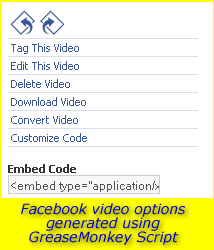
- I want to do it.
- Others must want to do it.
- Others must have figured out a way TO do it.
- I gotta find that way…
And indeed, a little googling turns up this great Greasemonkey script* (direct link to script page) which lets you generate an embed code. The script also creates links to download and/or convert the video to another format (through zamzar.)
This is going to be my new go-to method of embedding high quality video. Any other tips or tricks for embedding high quality video? I’d love to know how others do it. (Note: bliptv didn’t do so hot. Not sure why…)
Added 10/3/08 And here’s the result…
*Greasemonkey: A sweet little Firefox add-on that lets you to customize the way a webpage displays using small bits of JavaScript. It’s like a little miracle, and another not-so-small reason to use Firefox!!
Technorati’s 2008 Report on the Blogosphere–‘blogs are here to stay’

My last post at Library Garden was all about blogs attracting comments, and I continue to get comments and feedback about it. This morning’s post continues to highlight blogs, this time, in general and in detail.
For the last few years, whenever I was explaining blogs to library and school administrators, especially regarding their impact and trends, the report(s)/site(s) I would demo first were the “State of the Blogosphere” reports from Technorati. I was and continue to be impressed with the amount of valuable material Technorati has collected about the blogosphere on its site, but since November last year, I have been wondering if they would continue with their “State of…” reports. In fact, I finally removed a slide from a Web 2.0 intro presentation linking to the latest one from them, an April 2007 report, since the data was just too far out of date now.
Well, I was very pleasantly surprised to hear about a new full Technorati report on the horizon from Greg Jarboe’s post at SearchEngineWatch.com (one of my favorite places to stay-up-to-date on everything Web-related) late yesterday afternoon, and I look very much forward to reading and sharing the entire report.
Read highlights [from the post by Greg Jarboe at SearchEngineWatch], such as this:
Blogs are now a pervasive part of our daily lives. While there have been a number of studies conducted that tried to understanding the size of the Blogosphere — both in terms of the number of blogs and blog readership — all of these studies agree that blogs are now a global phenomenon that is “mainstream.”
Technorati cites the numbers from three of the studies, which vary in the details but generally agree that “blogs are here to stay.”
As of this morning, two of the five segments of the report, to be “released in five consecutive daily segments” are available, and this year’s report provides a lot of data thus far and it surveys many bloggers. While you wait for segments 3-5 of the full, detailed report, get started by reading the “Introduction,” Segment/Day 1: “Who are the Bloggers?,” and Segment/Day 2: “The What and Why of Blogging” over at Technorati. Do take the time to visit, because if you have any interest in the latest impact and trends associated with blogs, you will be educated and impressed with the detail of their latest report–I certainly was!
-Robert Lackie
Technorati Tags: blogs, blog report, blogger surveys, technorati, Library Garden
Banned Books
Time Magazine has written a feature article on John McCain’s Vice Presidential candidate Sarah Palin. Below is a paragraph from the article that discusses her relationship to the public library while Mayor of Wasilla Alaska:
“Stein says that as mayor, Palin continued to inject religious beliefs into her policy at times. “She asked the library how she could go about banning books,” he says, because some voters thought they had inappropriate language in them. “The librarian was aghast.” The librarian, Mary Ellen Baker, couldn’t be reached for comment, but news reports from the time show that Palin had threatened to fire her for not giving “full support” to the mayor. “
The full article can be found here.
What do you think? At what level should government be involved in library decisions and policy (i.e. we get our funding from them but does that mean they can tell us how to spend it)?
The Truth Is Out There–We Are Not Alone!
In today’s New York Times, Michelle Slatalla writes about turning to the Internet for advice for dealing with ‘life’s little insoluble conundrums’–in her case, a smoke detector going off in the night. In the article, she talks about services like Wiki.Answers, Amazon’s Askville, Funadvice.com, Askmehelpdesk.com, Help.com, and Yahoo Answers to ease the helplessness we all feel when life throws us a bizarre curveball.
I immediately thought of the new NJLA and New Jersey State Library new marketing campaign called Solving Life’s Little Problems. This is exactly what Ms. Slatalla was talking about–I have tried everything I know, now what? Hers was not a huge problem, but it was annoying and a big deal to her. Yet despite noting that at times the answers on these sites is often wrong and noting ‘the answers don’t go through fact checkers’, the article never mentions professional library services such as QandANJ.org.
I wanted to scream! Why are we being ignored? Why aren’t you writing about us? How can you know the information can be bad, but still extol the virtues of such services? People have questions. Libraries have answers–even 24 hour Internet Access to answers!
We need a new marketing campaign. These services are getting the word out better. The article states that Help.com has had a 73% year-over-year increase in traffic to 316,000 visitors per month! That is huge. Compare it to the very successful QandANJ.org service that gets around 4,500 users a month (keeping in mind it is live and it is branded in one state vs. Help.com being a worldwide post and wait service so it is not an apples to apples comparison, but still…). I am in the process of writing Ms. Slatalla (slatalla@nytimes.com) to let her know The Truth Is Out There! We are ready and able to ‘Solve Life’s Little Problems’, 24 hours a day, seven days a week.
Still, the article serves as a wake-up call for me–We Are Not Alone! I think we need to understand what these competing services offer users and learn from them. For example, lurking–you can sit and read volumes of previous posts on a topic without the need to ‘come out’ to a live librarian. I know of no similar service offered by Libraries. We provide pathfinders to resources, but what about answers FAQs?
Likewise, some of the questions asked are real stumpers that I am not sure how well they would be answered by librarians. For example, in the article, one question listed is ‘When you make out with a boy or girl, what do you do with your tongue?’ Honestly, I have no idea how I would answer that (but you can bet I will go out and look at what was posted and hope to learn something new in the process!). How would you answer this?
This isn’t the first time library services have been ignored by Ms. Slatalla. In January she wrote about Tutor.com (here is the article). Again, she never mentions that this service and many other homework help services are available, for free, from many public libraries. In fact, there are many times when her Cyberfamilias column talks up services we provide without mentioning us as a reliable on-line service provider. She is not alone. There are many other examples of the media reporting about on-line information sources that never mention libraries.
This needs to change. I call on Librarians and Information Professionals to write to Ms. Slatalla (slatalla@nytimes.com) as I am. Let her know about what your library can do for her and her readers. Then don’t stop there–tell everyone you know about on-line services that are available 24/7 and then tell everyone you do not know. Tell every in library patron what they can use when the library is closed. Let people know–The Truth Is Out There! It can be found at your library!
I AM WHAT I AM
Since Julie tagged us over here at LG in the Superstararchivists meme on ‘how you got into libraries’ I am taking up the keyboard! I’ve really been enjoying reading all the other stories and seeing the similarities and differences, and reading all the comments!
I’m sure I’ve told this story to several people, but I’m not sure if I’ve written it anywhere… my journey to librarianship starts out with me never having had any idea what I wanted to be when I grew up!
I felt supremely jealous of the people I knew who seemed to know just what they wanted to do for the rest of their lives. The college students who were getting degrees in something specific, something they could DO or BE at the end of four (or more) years … the classmates who were already planning to be pre-med, or go into business, or become teachers … the even younger friends from my early childhood (“I want to be a fireman!” “I want to be a chef!” “I want to be a mom!”) made me feel so left out.
Not having any plan in mind, I pursued “liberal arts” (like all other confused, direction-less sorts I guess) at a “liberal arts” college, hoping to stumble upon IT. IT, you know, what I would want to do or be forever! This allows one to keep all options open and to hopefully emerge as a well-rounded individual at the very least (though probably a very impoverished one).
I entered as “undeclared” my freshman year. I spent a brief time as a Sociology Major (until I found out we would have to spend a lot of time in a local prison for one course, and I was out of there). Then, not being allowed to return to “undeclared” status, I chose English (the safety net for all). This only lasted until I finished my first few Philosophy classes and found myself signing up for as many more as I could! I came to the utterly logical conclusion that if I were going to take so many Philosophy classes, I should major in it.
I love Philosophy classes.
I am going to take as many Philosophy classes as I can.
Therefore, I will be a Philosophy Major.
(Okay, so my Logic is a little rusty!)
Of course, this created the corollary:
So, I graduated with my Philosophy Major* and could not stand the thought of ANY MORE SCHOOL (bye-bye law school)! I went to work in the publishing industry in Manhattan for several years. When this was ultimately unsatisfying to me (especially the NJ-NYC commuting), I began to look around for another career. I was willing to go back to school, but only for something that I really wanted and would really love. I took a job as a administrative assistant at an engineering company close to home (no commute!) while I (again) searched for what it was I would BE.
Fully convinced I had NO INTEREST whatsoever in anything related to ENGINEERING, I decided to look for a similar office job in a different setting while I continued the search for my ultimate career.
On a regular trip to my local public library one day during this time, I noticed a sign advertising for an administrative assistant in the library! Ah, same “just a job” job, but more pleasant environment! Ah, I could go to the library everyday – wonderful!
Now, I had always been an avid library-user and read my entire life. My mother and brother and sister and I were regulars and would routinely leave with bags and bags full of books. I had spent many hours in the library – both for pleasure and for schoolwork, but IT HAD NEVER OCCURRED TO ME TO WORK IN A LIBRARY. NOT EVER. NOT ONCE. I had never thought about who these people working in the library were, what their qualifications or jobs might be. I had NEVER in my entire life of library patronage ever considered being a librarian. In fact, I had NO IDEAS about that job at all (something that makes me wonder to this very day how it could be so and what’s so very wrong with that picture, and what needs to be done about it…..)
I applied for the library office job (and didn’t even get a call actually) but I also started RESEARCHING what this librarian job was all about. The main things I found out were:
- It requires a Masters Degree, and is a REAL PROFESSION (what I was looking for)!
- It has to do with books, reading, AND COMPUTERS (things I LOVE)!
- It involves sharing INFORMATION and helping others FIND their INFORMATION (something I already did with a passion)!
PERFECT!!!!! I had found IT. IT – the thing I wanted to DO and BE for the REST OF MY LIFE!
I found out how to become a librarian (step 1: take the GRE – yikes! – step 2: commute to Rutgers for a long time) and started telling friends and family of my PLAN! The reaction was the same from almost every single person I told:
“THAT IS SO YOU!”
“YES, THAT’S EXACTLY WHAT YOU SHOULD DO!”
(Oh, duh, of course, well why didn’t any of you let me know sooner?!)
I began my library studies and soon after got a part-time job as an intern at the wonderful Clifton Public Library. (I had been hoping that I would LOVE the public library, even though I knew there were other possible types of libraries to work in, but public was what I wanted to love and, lucky me, I DID!) This position soon wbecame full-time while I continued with school, and then become a full librarian job upon graduation! I have since worked at the also-wonderful Paterson Free Public Library and now work for the really wonderful central regional library cooperative!
So, there really was no “one thing” that led up to my self-discovery that I was really a librarian deep down inside all along. It was just a series of regular little steps along the path of life that only prove to have been heading in an ultimate direction once you’ve arrived at the end and look back.
And, just to be clear, I do consider myself to BE a librarian. Even though my current job title does not include the word library anywhere in it, it is what I am, it is who I am, and I am so glad!
* Actually, I have since found MANY librarians with B.A.’s in Philosophy. Also, my sister went on to major in Philosophy and is doing just fine, thank you very much!
Email Habits of Library Workers
About a month ago I posted a simple poll using Doodle to get a quick snapshot of the email habits of librarians and those who work in libraries. I am finally finding a few moments to summarize the results. This is not a very scientific study at all, but it does give an indication that many of us in libraryland seem to feel compelled to check our work email even on weekends and holidays. I wonder if this is the same in other industries or are we just a hyper-connected profession of overachievers that must know at all times what is happening in our libraries even when we are not there?
As of August 15th 2008 there were 160 responses (many more than I expected) and the most popular option chosen was “Yes on weekends” with 119 people (74%) indicating that they needed to know what was going even when they were not at work.
Even though we seem to have a burning desire to check our work email on weekends, there is some indication that at least a small portion of the profession knows the meaning of the word vacation — 51 people (32%) indicated that they do not check work email while on vacation. Conversely, though, that means that more than two-thirds check work email when they should be sipping margaritas or relaxing on the beach.
Here is a quick summary of all the responses (results do not equal 100 as it was multiple choice):
 Although the numbers in and of themselves are interesting, what I found most fascinating was the long list of comments. Here are a few sample comments:
Comment by Eileen. (Monday, July 14, 2008 3:11:27 PM CEST) Less so at night but definitely on weekends and vacation. I’d rather spend a few minutes a day keeping up with it than deal with it when I get back. When I’m on vacations I will hit the delete key more quickly — especially with list mail. Anytime I’m at home or on vacation I tend to respond to only what I need to. I almost never check work-related blogs though.
Comment by Patty. (Monday, July 14, 2008 3:48:31 PM CEST)
I’ll check it occasionally at night through the week and usually every weekend at least once or twice, but I rarely act on anything unless it is dire. It can usually wait until I get to work but I am curious to see what is going on.And, perhaps most wise of all:
Comment by Becky. (Tuesday, July 29, 2008 11:57:32 PM CEST) follow up – I have a friend who says no one ever died of a Library emergency, and I try to remember that, even as I’m checking.
I have been trying to check my email less frequently when I am not at the library with some measure of success and I think my life is better for it. Still, I mostly fall in the camp of wanting to know what is going on (even if I don’t respond to the message) and being able to delete anything unimportant over the weekend to make re-entry on Monday easier. It seems as if curiosity is a trait of many who are constant email checkers.
I used to check less frequently from home on weeknights, but since I took over as PPL’s program coordinator I find that it often puts my mind at ease to check email quickly after 9 pm to get the update on how the evening went at the library. We have programs almost nightly and when someone else is covering the program I want to know if things went smoothly. I know that I can do nothing about it from home if things went wrong, but still I seem to need to know.
Perhaps library workers need to follow the popular trend of having a Technology Sabbath — ditching email, all online communication and our cell phones for one day each weekend. It would be tough for many, myself included, but it is something worth considering.
Please take a few moments to scroll way down and read the rest of the comments left on the poll. Also feel free to leave comments on this post about your email habits — and if you plan to change them in the future based upon this unscientific research.
Education Resources Information Center (ERIC) Provides More "What Works" Than You Probably Knew

Last week, Patricia Dawson (the Science Librarian at Rider University) and I (the Education Librarian) did a library research instruction session together at our Rider University Libraries for students in a math curriculum course in our the Master of Arts in Teaching program. We, of course, discussed, demonstrated, and provided hands-on time for several databases and Web sites that we subscribe to or visit regularly to keep up with various reports and research on improvements in education. Besides looking for articles by particular authors on the topic of teaching fractions, they were also looking for substantive intervention reports and proven practical information guides regarding various teaching strategies. The students were very pleasantly surprised by several database findings and sites, including our EBSCO ERIC database, and what replaced the AskERIC site–The Educators Reference Desk. Both were extremely useful in their research, and it was the reminder email I received from ERIC News earlier today about their newly redesigned Web site that reminded me that many education students, current teachers, and professors in undergraduate and graduate education programs are not familiar with particular valuable publications available via ERIC, even if they have previously used the ERIC database. I meant to blog about this earlier this week, but it is never too late to share valuable information!
Because we subscribe to the ERIC database via EBSCO now, I don’t regularly go to the free ERIC Web site, but I was reminded of its usefulness. Earlier this week, ERIC provided detailed information on its new Web site structure and design at http://www.eric.ed.gov/.
The new ERIC Web site features several enhancements that will make the experience of using the site easier and faster for individual researchers, along with improvements to aid librarians in supporting ERIC users. These enhancements include improved navigation, expanded help and training, an information area for librarians, and a lighter visual design.
More detailed information on their new look and feel is available at their site, and I must say that I did appreciate the new Information for Librarians section of their site; however, it was the full summary of and full text reports and articles from one of two of ERIC’s special featured publication sections that really impressed the students and professor, and I wish to highlight it: The What Works Clearinghouse, housed at the Institute of Education Sciences (IES) site, which “brings rigorous and relevant research, evaluation and statistics to our nation’s education system” since 2002 and also features four famous research and data IES Centers, as well as funding opportunities and the other ERIC special publication: The Regional Education Laboratories–all worth exploring.
 The What Works Clearinghouse (WWC) began in 2002, and its newly redesigned site provides exactly the type of information researchers and teachers are looking for–a central, trusted site for full text reports and articles on the scientific evidence for what really works in education. Our students loved this site, especially for its topics of Elementary School Math and Middle School Math. Check out the “Topic Report” and “List of all Intervention Reports” links under each of the topics, which in addition to math provide fantastic info on Beginning Reading, Character Education, Dropout Prevention, Early Childhood Education, and English Language Learners. Useful explanations of the difference between Topic Reports and Intervention Reports, although very related, are provided (linked above)–this question came up often in the research sessions.
Being a very practical researcher myself, I like to point out other very interesting areas of the WWS site: their Practice Guides (providing recommendations and strategies for classroom teachers on several challenging topics) and Quick Reviews (providing, well, quick reviews, of “timely and objective assessments of the quality of the research evidence from recently released research papers and reports,” K-12+).
I found myself just as enthralled with this WWS site as the students and professor, and was happy that I revisited the new ERIC site. I believe you will find this site and other related ERIC sites very practical and useful as well. If you have other different “favorites” to share with readers of the Library Garden blog, please feel free to comment and get the word out!
-Robert Lackie
Technorati Tags: Education Resources Information Center, education, Institute of Education Services, What Works Clearinghouse, Library Garden
The New WebJunction is here!
My new profile on WJ is set up and ready to go and I am stoked! A huge congratulations to the entire team at WebJunction for all their hard work in creating a dynamic and interactive site for library workers to gather online (I know some of the key players, but I am sure there are many more behind the scenes that I have yet to meet). I spent a few hours last night “playing” around with the new interface and gathering some friends and I am impressed.
I have been a member, moderator and advocate for WebJunction since I first met Chrystie Hill at the OCLC booth during ALA Annual in Toronto way back in June 20003. Chrystie’s enthusiasm was so infectious that I signed up on WJ my first day back at work and have not looked back since. In addition to moderating, I have assisted with various projects over the years and as a result have found advice, ideas, support, and friendship — all the things that keep one coming back to an online community.
I have been anticipating the release of the new WJ for many months now. I talked to Michael Porter during PLA last March and when he told me of some of the plans (at least that which he could reveal) I knew immediately that it was going to great — and it is.
One of the features I am liking best at the moment is the ability to create your own group and I have already set up a group called Public Library Programming for Adults. I am currently the only member, but membership is open to all who are currently providing programming or thinking about it in the future.
I have found navigating the new site to be easy, my only minor complaint is that it seems to be a bit slow in loading new pages. If you want an overview and some advice on how to get going there is an online training video to help you out. I already feel like I have found a new online home and I look forward to seeing soon you on WJ!


 Library Garden
Blogs that Attract Comments: Are You in the Active ‘1%’ ? Do You Want to Be?
The information above is only a very small part taken from a very engaging and interesting, and I think, on-target article by Lindy Dreyer and Madie Grant, entitled “Why Doesn’t Anyone Comment on Your Blog?” in the Associations Now Sept. 2008 publication. Many tips on writing style and basic content for blogs, all encouraging blog comments, are provided, with information on the types of blog posts and styles of blogs adapted from an excellent SlideShare presentation from Rohit Bhargava and Jesse Thomas also worth viewing: “25 Basic Styles of Blogging: And When to Use Each One.” Apparently, Bhargava put this up on SlideShare some time ago, since it has “55810 views 35 comments 606 favorites 334 embeds,” but I found it very pertinent still.
Back to the Association Now article–the authors provide 5 strategies to draw in blog readers and commenters, and various tips for what to do and what not to do to keep them coming back, including possibly changing “subscribe” with “get updates” and “trackback” with “blogs that link to this post,” among others.
Whether you are new to blogging or not, do take the time to read this article and its recommended links, not to mention the article’s comments and the bibliography provided at the SocialFish post (along with the SlideShare presentation mentioned above, found again at the bottom of the bibliography).
Although written to and for associations and organizations to help get the conversations going on their blogs, the advice and tips provided here are extremely pertinent for individuals as well. I am always attempting to give practical advice on blogging, but this is one of the best articles on attracting readers and commenters that I have read this year. I especially liked their detailed information about the five qualities common to many blogs with a vocal audience (i.e., strategies). I hope you enjoy learning from this, as well, and that you share it with other bloggers.
-Robert Lackie
Technorati Tags: blogging tips, blog comments, online communities, social media, Library Garden
September 16, 2008 at 9:09 am Robert J. Lackie 16 comments