What’s happening? The story of my Twitter evolution…
by Cynthia Lambert
A funny thing happened on the way to the weekend: I found myself on Twitter looking for stuff to do!
Now don’t get me wrong–I have been on Twitter. I signed up about two years ago and have used it sporadically ever since. I like the short bursts, but they often are just links to typical stuff found elsewhere. Plus, my choices of who to follow were often disappointing. Not the real people I actually know! It was the content providers and entertainment choices I made that fell short.
From the input side, I posted some. That was fun, especially the phase where I tried to make every post use as close to the total 140 characters as possible. Still, after posting to Facebook, I didn’t find I had anything new to say. Mostly, I glanced and moved on. That began to change when I was planning my vacation.
I was heading to Northern California and some pretty tiny towns. I certainly used Google to plan and prep for the trip. However, I couldn’t get any real sense of the towns or what there was to do after hiking all day. At some point, I thought maybe I could follow a local library twitter feed and find out a few things happening while we were going to be in town. I dug about further and found a local paper, the local college, and a few government feeds for my destination. Boom, I finally found my Twitter sweet spot!!

Mentioned in a Tweet about a garden walk in Mendocino!
I found information about food, gardens, and shopping. I even found a yarn shop via a garden walk. Now folks, these are a few of my favorite things! I gleefully watched the feeds for a few weeks before we arrived. It was a great trip.
After vacation, I returned home and reverted back to my Facebook and Google habits. For a few weeks that was just fine. However, one day I glanced at my Twitter feed just as @PrincetonScoop posted about an event for that weekend. The scales fell from my eyes and behold, I became a Twitter convert!
Once again, I dug around for the local newspaper, the local university and colleges, the college radio station, and a few commercial PR providers. I added a few local places I frequent. I was on my way. A treasure trove of information began to flow in: Farm Market Updates; what’s blooming in the local gardens; summer theater options at Princeton University, and of course all the great events hosted @mylibrary.
The moral of this story–always look at your resources and tools with fresh eyes.
I thought I knew what Twitter had to offer, but I was wrong. What it is, and what I want from it, have evolved over time. I now visit Twitter before I hit Facebook. I still don’t post much, but that is because I am too busy planning what to do this weekend!
Officially Weighing in on QandANJ
Posted by: Janie Hermann
Tomorrow afternoon at 1 pm the Reference Section of NJLA will hold a meeting at Princeton Public Library so that the library community can have a dialogue on QandANJ.org and on the state of virtual reference in New Jersey.
I personally hope that the room will be packed to standing room only so that we can get as many opinions and ideas as possible. My fear is that attendance will be much smaller than it should be. I know that some will not be able to attend due to other work commitments, desk schedules, or travel distance (NJ is a pretty big state). If you are in that category, please take the time to share your thoughts with Michael Maziekien, the chair of the NJLA Reference Section, or leave comments in this post.
If you are still hesitating about attending for other reasons — such as apathy or not wanting to “rock the boat”, so to speak — then I encourage you to reconsider and take the time to come tomorrow. The key issue with this entire kerfuffle is not the decision to end funding for QandANJ, but the manner in which it was done. A decision about a statewide initiative that is staffed by librarians from over 50 libraries was made without any input from the stakeholders. This our chance to rectify the situation and have our say.
Until today my involvement with this issue since it surfaced about 5 weeks ago on April 4th has been to make several (some quite lengthy) comments based upon posts by Andy Woodworth and Pete Bromberg and to speak with other in our library community who are feeling the same sense of betrayal and shock over this decision. Pete and Andy have done an excellent job of framing the entire situation so I will not repeat what have they have said, but I did want to go officially on record as supporting their efforts to get the conversation started and not let the closure of a long-standing and beloved service be done without giving it a full and considered examination.
Tomorrow is not a “Save QandANJ” rally. It is a chance for open dialogue in which we can take steps to decide the future of virtual reference service in our state. It may very well be that the time has come to sunset QandANJ and even those of us who have been most vocal about this issue recognize this reality. Or it may simply be time to retoool the service, find new a funding model and/or scale down the service to recognize that many libraries have their own VR service and no longer need to be a member of the project.
The point is that we need to examine figures and facts, collect opinions from all sides both pro and con and then come to a consensus. This process won’t happen in one day or one meeting and I am very relieved that QandANJ has been given a reprieve to allow us time to figure this out.
I am also grateful to the NJLA Reference Section for taking the initiative to get the conversation started by calling this meeting and to Pat Tumulty and the NJLA Executive Board for issuing a statement that began with this sentence:
NJLA believes the library community must have a voice in determining the programs and services provided by state and federal dollars to the residents of New Jersey.
I have long been an advocate of the NJ State Library and have served on several committees for them over the years, including the Blue Ribbon Panel on the Future of Libraries. I continue to be proud of the innovation that is sparked in the NJ library community with the leadership of our state library. The NJ State Library has led many successful marketing initiatives that have raised the profiles of libraries and shown our value to our stakeholders. My disagreeing about the manner in which this one decision was made does not mean that I am no longer an advocate for their work or any less proud of the innovative services they provide. It simply means that we do not see eye to eye on one issue.
Some in the library community feel that those who are being vocal in their opinions are “betraying” the NJSL to openly call for a reversal of this decision and to request a meeting to discuss the future of the service. I do not see it as a “betrayal”. I see it as a way for all of us in NJ to grow as a professional community and am hopeful that the outcome will be a new way of doing business, one that is transparent and open and important decisions are given due consideration.
This has been a divisive few weeks for many, of that there is no doubt and it was evident at the NJLA conference last week. I know it has been very upsetting for many people for a variety of reasons. Let’s put that all behind before 1 pm tomorrow and work together towards a solution. If you have yet to feel free to speak up about your feelings on this issue, please find your voice and give us your feedback. Your ideas count and can impact the future of service for all New Jersey residents.
National Library Legislative Day 2011 is Here!
Posted by Robert J. Lackie

National Library Symbol
Libraries are increasingly essential in these tough economic times. People are flocking to our nation’s libraries for job and career information, small business research and e-government services as well as support for formal and informal education and lifelong learning. Congress made across-the-board cuts to federal programs in its FY2011 budget, and libraries fill the gaps made when other agencies and services. Unfortunately, libraries are also receiving federal budget cuts.
 Even if you can’t make it to Washington for National Library Legislative Day on May 9, you can join us by contacting your representatives and senators during Virtual Legislative Day. Please contact your elected officials with the following requests:
APPROPRIATIONS FY2012
- Fund the Library Services and Technology Act (LSTA) at $232 million, the level last authorized in December 2010;
- Preserve the Improving Literacy Through School Libraries program with its own budget line and appropriate the program at its FY2010 level of $19.1 million;
- Maintain funding for the U.S. Census Bureau’s Statistical Compendia Branch at $2.9 million in order to preserve publication of “Statistical Abstracts” and other publications;
- Fund the Salaries and Expenses work of the Government Printing Office (GPO) at $42,173,000 to preserve public access through the FDLP and FedSYS.
Elementary and Secondary Education Act (ESEA) (School Libraries):
- Support student performance by including an effective school library program as part of ESEA through the LEARN Act to include:
- A school library staffed by a state-certified school librarian;
- A school library with up-to-date books, materials, equipment, and technology, including broadband connectivity; and
- Instruction by librarians for students and staff on digital and computer literacy skills, including collaboration between classroom teachers and school librarians to develop and implement the curriculum and other school reforms.

American Library Association
While these issues are the most urgent at this time, there are many other critical pieces of legislation impacting libraries. For full list of key issues that will be discussed at National Library Legislative Day, click here. ALA has also drafted issue briefs on the following areas: Access, Appropriations for Libraries, Broadband & Telecommunications, Copyright, Elementary and Secondary Education Act, Government Services & Information, Surveillance & Privacy and the WILL Act
Visit http://capwiz.com/ala/issues/alert/?alertid=44989511&queueid=[capwiz:queue_id] to learn more and send your congressman and senator a message.
-Robert

Robert J. Lackie
Complimentary Downloads from Salem Press Concerning Osama bin Laden & Terrorism
Posted by Robert J. Lackie

Milestone Documents in American History
In an RSS feed I received today, Peter W. Tobey at Salem Press (ptobey@salempress.come) wrote that they were now providing free articles or chapters from published Salem reference books dealing with Osama bin Laden and terrorism. After reviewing them tonight while working the Reference Desk at Rider University Libraries (and missing the awards ceremony at the NJLA 2011 Conference for the first time in years!), I agree that many may find these free, quality resources of interest combined with other current resources within our databases, especially in light of current events. Mr. Tobey writes:
Milestone Documents in World History
“Osama bin Laden’s death returns us to the subject of September 11, 2001 in a number of ways. But the events of that day, the personalities, frustrations, and cultural clashes involved are far from straightforward. And the repercussions are, of course, far-reaching. Salem Press has published a great deal on the history, biographies, religious and cultural backgrounds of terrorism. Perhaps most significantly, Salem has brought libraries two critical works by the Schlager Group covering the original source documents (plus analysis) of works by both George W. Bush and Osama bin Laden. We’ve selected these and two other articles on this subject (from four different reference works) because we feel your patrons and students may find them informative. You may download them freely, print as many copies of these articles as you need, and distribute them any way you’d like:”
“George W. Bush’s Address to the Nation on September 11, 2001: The Full Text & Analysis” (1,186 and 4,920 words) from Milestone Documents in American History
“Osama bin Laden’s Declaration of Jihad against Americans: The Full Text & Analysis” (2,322 and 5,048 words) from Milestone Documents in World History
Great Lives from History: The 20th Century
Salem also has published a brief, helpful biography of Osama bin Laden and an overview of the war on terrorism. See links to these articles below:
“Osama bin Laden” (1,682 words) from Great Lives from History: The 20th Century
“The War on Terror” (4,656 words) from Weapons & Warfare


Weapons and Warfare
By the way, these four reference book resources (PDFs) from 2008 and 2010, listed above, can also be downloaded from Salem Press’ Issues Today site, under the subheading: “May 3, 2011 – Osama bin Laden and the War on Terror” and are part of a new effort Salem is beginning where they will post free, relevant articles from their reference works on current topics in the news. I noticed on their Issues Today site that they also have four resources (PDFs) under the subheading of “March 30, 2011 – Nuclear Power” listed below the above items on their Issues Today site.
I thought this information and Salem Press’ new site might also be of use to others, and complete information on the reference books containing the articles above are provided at the end of each PDF. Now, off to the NJLA 2011 Conference tomorrow, one of my favorite conferences of the year!
-Robert
Robert J. Lackie
Money Smart Week® @Your Library (April 2-9, 2011) and ID Theft Resources
Posted by Robert J. Lackie
American Library Association logo

Additionally, Rider University’s Center for Business Forensics (CBF) has hosted several free interactive panel presentations for the general public (students, staff, community members, etc.) and law enforcement personnel focusing on the major issues surrounding identity theft—including financial literacy—and providing insight into the widespread, varying, and serious nature of identity theft.
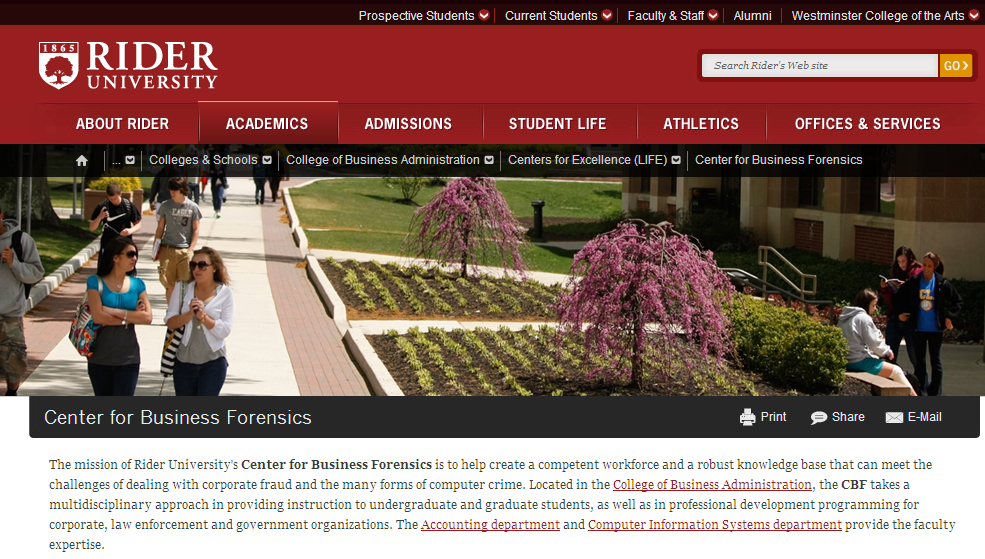
Rider University's Center for Business Forensics
1. Shred with a crosscut or micro shredder pieces of mail that contain any personal information before throwing them in the trash at home or at work.
2. Place outgoing mail and retrieve incoming mail via a locking mailbox or official Postal Service box.
3. Use a virtual credit card number (available through most banks) for online purchases, rather than your “real” credit card—connected to your card, the virtual number can be set up to only be used once, for that one online purchase (or for longer, but only if you wish).
4. Keep an eye on your credit card when you are paying for something—don’t allow it to disappear out of your sight (skimming of your card could occur).
5. Inventory/photocopy what is in your wallet/purse and place that photocopy (back and front of cards) in a locked cabinet—if your wallet/purse is stolen, you have all the info.
6. Never respond to an unsolicited email from your bank, medical organization, etc., and don’t unsubscribe—don’t even click on the link, just delete it.
7. Cover the ATM keypad from prying eyes and cameras with one hand while you enter your PIN.
8. Review your credit reports (you can get a free one each year from each of the three credit reporting agencies, and if you stagger requests, you can get one every four months).
9. Clear private data from your browser (i.e., Firefox, IE, or Safari): delete temporary files, browsing history, cookies, cache, saved form information, and saved passwords, especially when using a public computer or kiosk at a library, hotel, airport, coffee shop, etc., and then shut down your browser.
10. Use different passwords for different sites—and try changing/updating your passwords to passphrases.
Last but least, my annually-updated free website, Personal Profiles and Other Publicly Available Information: An Internet Hotlist on Detecting and Protecting Your Digital Footprint, contains some of my favorite ID theft protection, privacy information, and financial assistance sites, among other things, found on experts’ sites on the free Web, including our Identity Theft: What You Need to Know seminar project’s 29-page handout from Rider University, available to all.
Remember, according to Terri Cullen, author of The Wall Street Journal Complete Identity Theft Guidebook: How to Protect Yourself from the Most Pervasive Crime in America, ( “…Identity theft covers several different specific crimes, and collectively,…is one of the easiest crimes to commit, one of the hardest to prosecute, and one that is drawing increasing attention from the media.” So, feel free to share this information with all of your patrons and students, especially because proactively protecting your digital footprint and your finances is much easier than dealing with them after the fact as a victim—being a victim can be a very emotional, time-consuming, and financially-unrewarding process. Again, prevent it from ever happening to you, and help others do the same.
Money Smart Week @ Your Library
-Robert
Robert J. Lackie
Midwinter in chilly San Diego
by April Bunn
San Diego has a high today of only 59 degrees, so it’s not the warm getaway I expected, but it’s still a welcome relief from the piles of snow I left behind in New Jersey.
The 2011 ALA Midwinter Meeting is underway and today the convention center was full of dedicated librarians today, scurrying off to one meeting or another, or visiting the over 450 exhibitors.
I am always impressed at how well ALA does a conference. Every person I spoke to was helpful and friendly and the speakers here are always interesting- Neil Gaiman, Nancy Pearl, and Ten Danson are on the line up for tomorrow. I am really looking forward to attending my first Youth Media Awards on Monday morning.
As Vice President of NJASL, I’m here with our President Elect, Fran King and President, Judith Everitt to attend the Affiliate Assembly meetings for AASL. I respect all of you that are attending this conference and participating in multiple committee meetings to better yourself and this profession.
In these tough times, it is crucial that we network and advocate every step of the way.
“Happy Holidays!”: Important Travel Tips and Information to Help Ensure Happiness
Posted by Robert J. Lackie

Rider University Family Weekend 2010 image
As Rider University gets ready to close down at Noon today for our Christmas/Winter Break, many of our faculty and staff (the students are already gone!) are also getting ready to travel, as are many of the Library Garden team blog members. However, while working the Reference Desk yesterday and this morning at Moore Library, I fielded several interesting questions from faculty and community members about airline travel concerning checked baggage and travel with food/gifts (liquids & gels, in particular) that I thought would also be of interest to our blog readers.

Transportation Security Administration (TSA) logo
Besides the airline-provided information that our library patrons already possessed, I sent them both to particular sections of the U.S. Department of Homeland Security’s Transportation Security Administration main site (http://www.tsa.gov/index.shtm). There we found answers to their particular questions, among many other important travel tips and information; for instance, there was a very helpful “Airport Checked Baggage Guidance” page, an interesting “Traveling with Food or Gifts” page about packing these items, and–my favorite–the “3-1-1 for Carry-Ons,” detailing info about carry-on liquids/gels during airline travel (see the graphic directly below). Lots of very good travel tips and information can be found at the main site (and within the TSA blog), so check out the TSA site before you pack and travel.

Transportation Security Administration (TSA): 311 for Carry-Ons/Air Travel graphic
I hope this helps all of our Library Garden readers, and my esteemed LG colleagues, as much as it did our Moore Library patrons.
Everyone, please have a safe and happy holiday travel time–and I will “see” you all in our ‘garden’–next year!!
-Robert
Robert J. Lackie
A little love for libraries this holiday season
I love libraries (John LeMasney)
I just wanted to thank all of the libraries and the people and resources connected to those libraries I visited this year. Thanks for all they did to help me get the important stuff taken care of. Happy holidays!
– John LeMasney.
Note: this image originally appeared at http://365sketches.org/2010/10/05/328-of-365-is-a-love-letter-to-libraries-design-inkscape/

All Types of Libraries Invited to Join “Money Smart Week @ Your Library” National Initiative
Posted by Robert J. Lackie
American Library Association logo
The American Library Association (ALA) has announced in October 2010 a partnership with the Federal Reserve Bank of Chicago to make “Money Smart Week @ Your Library” a national initiative from April 2-9, 2011, and things are beginning to heat up now in late December—at least for this national initiative!

Money Smart Week logo
Celebrating its 10th year in 2011, Money Smart Week’s mission is to promote personal financial literacy (Note: Money Smart Week is a registered service mark of the Federal Reserve Bank of Chicago). Throughout the 10-year history of Money Smart Week, libraries have been instrumental in facilitating and hosting quality Money Smart Week events. For instance, libraries of all types in Illinois (and Chicago), Indiana, Iowa (and Quad cities), Michigan, West Virginia, and Wisconsin participated in Money Smart Week in 2010, partnering with community groups, financial institutions, government agencies, educational organizations, and other financial experts to help consumers learn to better manage their personal finances.
ALA and the Federal Reserve hope that even more librarians and their libraries will be participating in the first ever national Money Smart Week this spring, from April 2-9, 2011. Events will take place at member libraries across the country and will and cover topics from learning how to apply for a mortgage to teaching young people about credit. We all, librarians included, can benefit from that! Watch this site ( http://www.chicagofed.org/webpages/education/msw/index.cfm ) for information on joining the initiative, for news, and for important links you can use right now.
I will be posting again later this week requesting info from all Library Garden readers on programming ideas, as I am now, as of this month, on the Academic Money Smart Week @ Your Library Committee for ALA.
-Robert
Robert J. Lackie
The [sad] State of NJ School Libraries
by April Bunn
Is this some kind of nightmare? No, it’s really happening.
Our state is broke and they’re coming down hard on everyone, especially education to help make up much of the 2 billion dollar deficit. Our relationship with the state government is so bad that even our acting Commissioner of Education Rochelle Hendricks decided not to address teachers at last week’s NJEA convention, as has been tradition for years.
In my post a few months ago, I talked about the recent change of our title back to School Librarian. To quote myself, and where I was at the time, “I love my job, no matter what the name or the place is called. I pledge to continue to work as hard as I can to keep my board and community aware of what I am doing as Media Specialist, Librarian, or Teacher-Librarian in our Media Center, School Library, or Information Center.”

The war against NJ Govt.
Now it’s early November and the budget cuts were beyond devastating
to schools and school libraries. Entire districts, like Woodbridge, lost their librarians.
It’s estimated that hundreds of positions were lost. My little one school district lost its librarian too. Yes, as a result of the mid-March enormous state aid cuts, my Board was put in the position of cutting almost $500,000 and my position and program were included in those cuts (along with teachers, a secretary, all the lunch aides and part of our basic skills program). Note: I still have a job because in addition to my School Librarian certification, I also have an Elementary Teacher certificate. So, I’ve transitioned to the 2nd grade classroom of one of my colleagues who was let go.
Our library program was strong and popular. Some of the current Board members had been active volunteers through the years.
Just some of the programs that will be lost with this decision:
A Weekly Book Club, held at lunchtime
Poetry Cafe
Recess Library Assistants in 4th-6th grade
Bookmark Contest
Reading Contest
Six Flags Reading Club
Collaborative projects with tech, art, and language arts on subjects such as: endangered animals and alternative energy
Recess quiet reading/study area
Student book reviews
Iditarod Trail Sled Dog Race tracking
Award-winning books gallery
Reader’s advisory for emerging and reluctant readers up to voracious YA readers
Visits to the public library to promote membership and familiarity
What will happen to these libraries? In my school, classroom teachers are responsible for taking their classes to the library and allowing students to pick books. Parents in my community are volunteering to come and help with book re-shelving. While I’m always grateful for parent volunteers, they cannot replace a certified librarian. It’s a disgrace. The students will lose out in so many ways.
Pat Massey, past- President of NJASL, testified to Chairman Louis D. Greenwald and Members of the Assembly Budget Committee on March 25th, arguing that students need resource-rich school libraries that are staffed by state certified school librarians. The transcript can be found here.
I am sad and mostly angry at what happened here. To put salt in the wound, I am now Vice President of the New Jersey Association of School Librarians (NJASL) and am not even be doing the job while serving my term! I’ll work to advocate for the recall of these positions, but according my administration, we’re in this situation for a minimum of 4 years.
The outlook is bleak
I just saw a posting from a library school student on the YALSA listserv looking for a place to do her practicum in northern New Jersey and she is struggling to find a program that is still afloat. What does this mean for our award-winning MLIS/MLS programs that are producing excellent school librarians?
These budget cuts are far-reaching into the future of education. The New Jersey Education Association (NJEA) is fighting the cuts in education, and local teacher associations are rallying to get the public’s support. Barbara Keshishian, president of the NJEA, the state’s 200,000-member teachers’ union, said in a statement that the proposed budget “is a disaster for public school children and for older students who want to further their education beyond high school … Gov. Christie is slashing education in order to pay for tax breaks for the wealthy.”
Working hard and advocating for our jobs is the most important thing we can do right now.
Keep advocating. Don’t give up. Tell your towns that cutting school libraries (and public libraries) is not an option.
Keep the faith that we’ll wake up and find out that this was all a bad dream.


 Library Garden
Recent Comments